Lesson 7 · 10 min
Sizing options trades to a fixed account risk, and liquidity
You’ll learn
- How to size an options position from its maximum loss
- Why some spreads do not fit a small account's risk limit
- How bid/ask spread, volume and open interest affect real cost
7.1 Size from the maximum loss
In futures, sizing starts from the stop distance. With a long option or a defined-risk spread, the worst case is known in advance: it is the debit paid, or the width minus the credit received. So sizing starts there. The rule is: contracts = account risk in dollars / maximum loss per contract, rounded down.
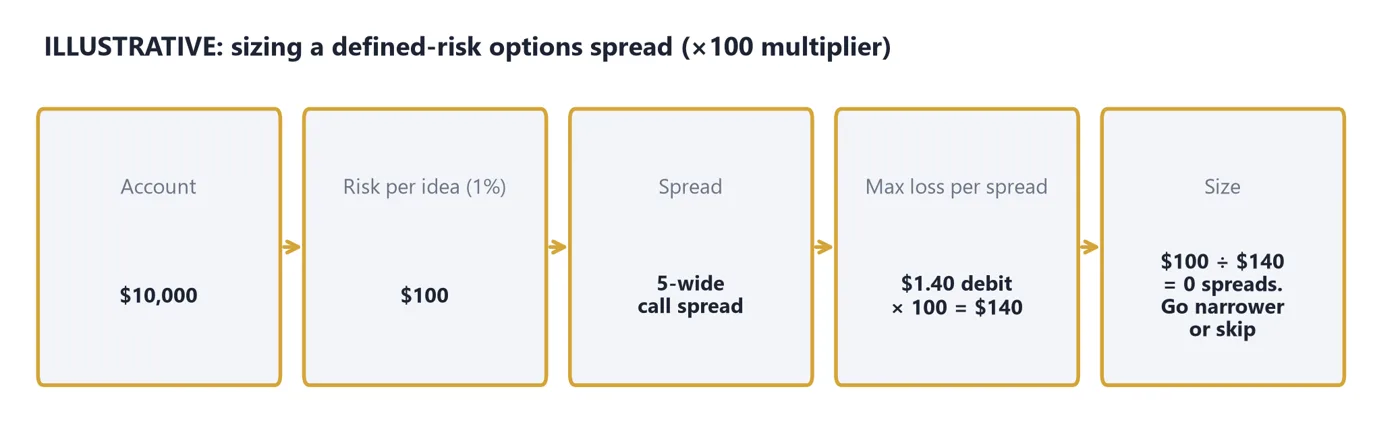
- 1Step 1: set the risk budget, for example 1% of the account.
- 2Step 2: find the maximum loss of one contract: debit x 100, or (width - credit) x 100.
- 3Step 3: divide the budget by that maximum loss and round down.
- 4If the answer is below 1, the trade does not fit the budget.
Hypothetical example. The account is $25,000 and the risk budget is 1%, which is $250. The 5-wide bull call spread from Lesson 6 has a maximum loss of $200 per contract. 250 / 200 = 1.25, so round down to 1 contract. The actual risk is $200, or 0.8% of the account.
Now the iron condor with a $400 maximum loss. 250 / 400 = 0.625, which rounds down to 0 contracts. The position does not fit the budget, and the correct decision is to skip it or choose a narrower structure. Squeezing in one contract anyway would risk 1.6% of the account.
Hypothetical example, small account. The account is $10,000 and the budget is 1%, or $100. A 1-wide spread with a 0.40 debit has a maximum loss of $40. 100 / 40 = 2.5, so round down to 2 contracts, a total risk of $80. The $200 spread from above gives 100 / 200 = 0.5, which is 0 contracts.
7.2 Liquidity: the cost you cannot see on the chart
Liquidity is how easily you can get in and out at a fair price. In options you check three things. Bid/ask spread: the gap between the best buy and sell prices. Volume: contracts traded today. Open interest: contracts still open from all prior days. High open interest and a tight spread usually mean easier trading. SPY and QQQ options are among the most liquid, but individual strikes and expiries still vary a lot.
Hypothetical example. An option is quoted 1.95 bid and 2.10 ask. The spread is 0.15, which is $15 per contract. The midpoint is (1.95 + 2.10) / 2 = 2.025. If you buy at the ask and could only sell at the bid, the round trip costs 0.15 x 100 = $15 per contract before any price change. On a $210 position that is about 7%. A four-leg trade has four spreads to cross, and the costs add up. Orders at the midpoint or a limit price can reduce this, but they may not fill.
| Check | Looks easier to trade | Looks harder to trade |
|---|---|---|
| Bid/ask spread | A few cents on a multi-dollar premium | A large share of the premium |
| Volume today | Hundreds or thousands | Zero or a handful |
| Open interest | Thousands of contracts | Under a hundred |
| Strike and expiry | Near the money, standard expiries | Far strikes, unusual dates |
Poor liquidity also affects exits. If a spread is hard to close, you may have to hold into expiry or accept a poor price. A stop order on an option can fill far from the trigger because the quoted spread is wide. Many traders use limit orders for options and avoid market orders on thin strikes.
A final note on futures options: ES options have their own multiplier ($50 per point), so the same sizing rule applies but the dollar maximum loss per contract is usually larger. Hypothetical example: an ES call spread with a 10-point debit has a maximum loss of 10 x $50 = $500 per contract, which would not fit a $250 budget at all.
- Contracts = account risk in dollars divided by maximum loss per contract, rounded down.
- If the result is below 1, the trade does not fit the budget; skip or restructure it.
- Bid/ask spread, volume and open interest are part of the real cost of an options trade.
- Multi-leg trades pay the spread on every leg.
Quick check
Pass with 2 of 3 to complete the lesson (+20 XP, plus 5 XP per correct answer the first time).
1.Account $20,000, risk 1%, spread max loss $150 per contract. How many contracts fit?
2.Account $10,000, risk 1%, spread max loss $300 per contract. What do you do?
3.A quote is 1.00 bid and 1.20 ask. What is the round-trip spread cost for one contract?