Lesson 6 · 11 min
Defined-risk spreads, and why undefined risk needs extra care
You’ll learn
- How a vertical spread caps both loss and gain
- How an iron condor is built and what its payoff looks like
- Why short options with undefined risk, early assignment and pin risk need extra care
6.1 Vertical spreads
A vertical spread combines two options of the same type and expiry at different strikes: you buy one and sell the other. The option you sell pays for part of the one you buy, and it also limits the gain. The maximum loss and the maximum gain are both known when the trade is opened.
Hypothetical example, bull call spread. SPY is 600. You buy the 600 call for 4.50 and sell the 605 call for 2.50. The net cost (net debit) is 4.50 - 2.50 = 2.00, or 2.00 x 100 = $200. The width between strikes is 605 - 600 = 5.
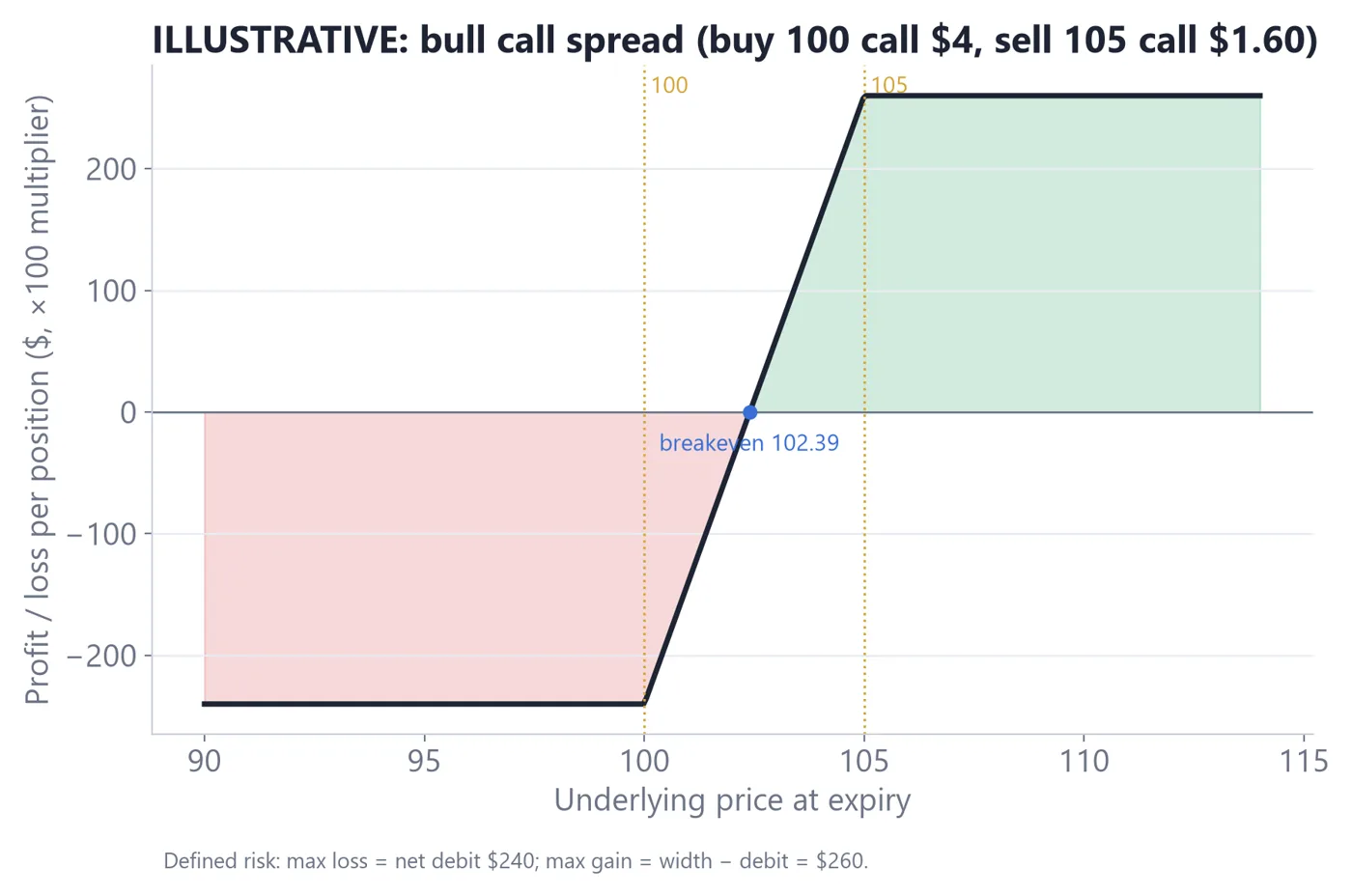
- 1Below 600 both calls expire worthless: the loss is the debit, $200.
- 2The breakeven is the lower strike plus the debit: 600 + 2.00 = 602.00.
- 3At 605 and above the gain stops: (5 - 2.00) x 100 = $300.
- 4Risk is defined: the most you can lose is $200 and the most you can make is $300.
Compare it with the single 600 call from Lesson 2: the spread costs $200 rather than $450, and its breakeven is nearer (602.00 versus 604.50), but the gain stops at $300. You gave up the upside above 605 in exchange for lower cost. A bear put spread is the mirror image for a falling market.
6.2 The iron condor
An iron condor combines a put spread below the price with a call spread above it, both sold for a net credit. It has four legs. It earns its maximum if the underlying finishes between the two short strikes, and loses on a big move in either direction.
Hypothetical example. SPY is 600. You sell the 590 put at 1.20 and buy the 585 put at 0.70. You sell the 610 call at 1.30 and buy the 615 call at 0.80. The net credit is 1.20 - 0.70 + 1.30 - 0.80 = 1.00, or $100. Each side is 5 points wide.
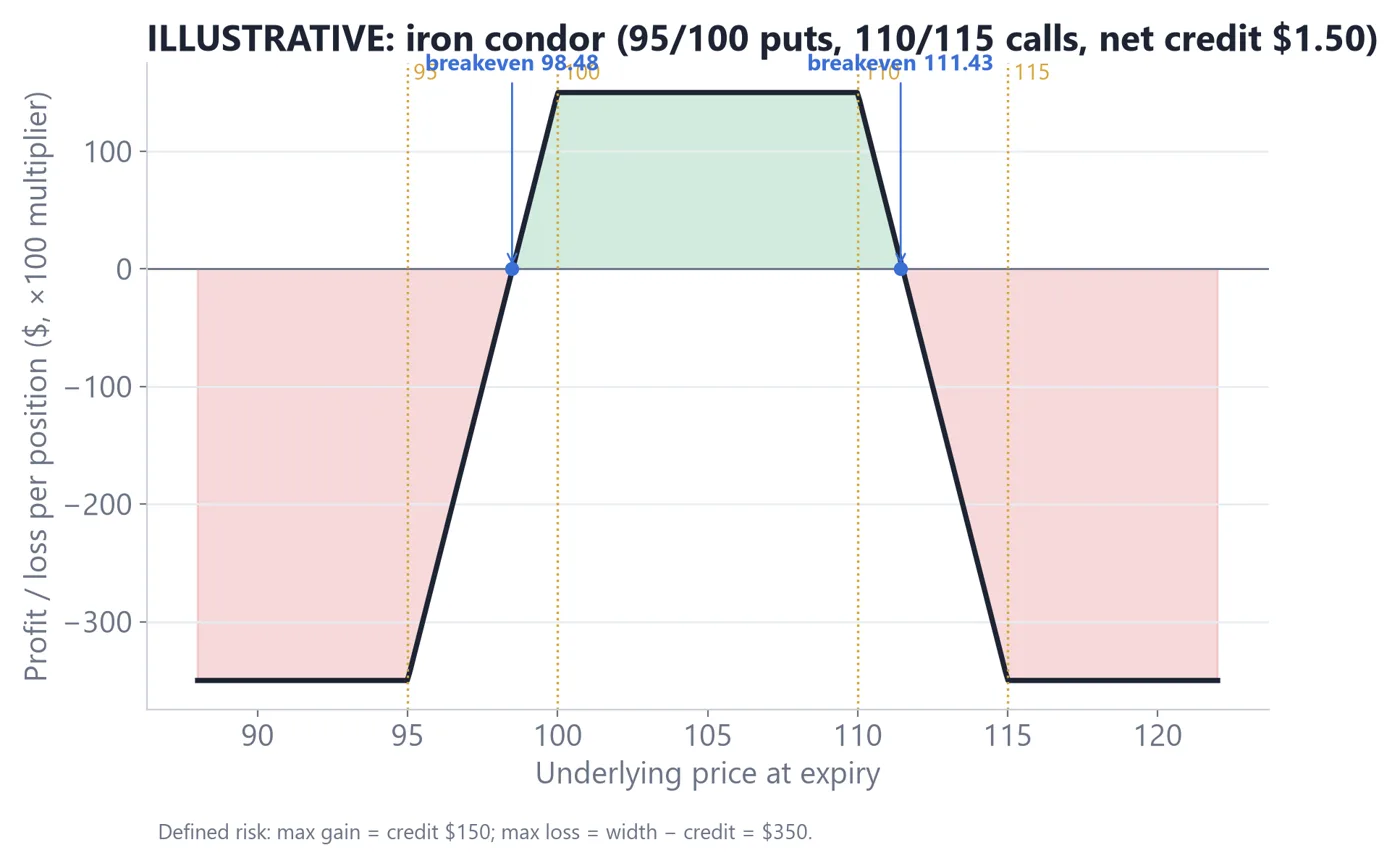
- 1Between 590 and 610 all four options expire worthless and the credit of $100 is kept: this is the maximum gain.
- 2Breakevens are 590 - 1.00 = 589.00 and 610 + 1.00 = 611.00.
- 3Beyond 585 or 615 the loss stops growing: (5 - 1.00) x 100 = $400 is the maximum loss.
- 4The maximum loss ($400) is four times the maximum gain ($100).
The shape shows a trade-off: a wide zone where the position keeps a small gain, paid for by a smaller zone where it loses more than it can make. Iron condors are defined-risk, yet the defined loss can still be large compared with the gain. Whether a given setup is worth taking depends on your tested data and your risk limit (Lesson 7). It is not endorsed here.
6.3 Undefined risk, assignment and pin risk
Early assignment. American-style options such as SPY and QQQ can be exercised by the holder at any time. If you have sold an option that is in the money, you can be assigned before expiry, and you receive an obligation to buy or sell 100 shares per contract. This is more likely for deep in-the-money options and for short calls just before a dividend date. In a spread, the long leg can protect against a loss but it does not always arrive in time: you may be assigned shares or a short stock position overnight, with a margin call and a morning decision. Know your broker's rules.
Pin risk. If the underlying finishes very close to a short strike at expiry, you may not know until after the market closes whether you were assigned. A weekend's news can then change the value of the resulting stock position. Many traders close short-option positions before expiry to avoid this uncertainty. On options on futures, assignment gives you a futures position at the strike, with its own margin requirement.
- A vertical spread caps both the loss and the gain; compute max loss, max gain and breakeven before opening one.
- An iron condor has a small, wide-zone gain and a larger defined loss.
- Naked short calls and puts are undefined risk and can lose more than the account.
- Early assignment and pin risk are real for American-style options; know your broker's rules.
Quick check
Pass with 2 of 3 to complete the lesson (+20 XP, plus 5 XP per correct answer the first time).
1.A bull call spread buys the 600 call at 4.50 and sells the 605 call at 2.50. What is the maximum loss per contract?
2.An iron condor is opened for a 1.00 credit with 5-wide wings. What is the maximum loss per contract?
3.Which position has theoretically unlimited loss?