Lesson 5 · 10 min
Implied volatility, earnings and IV crush
You’ll learn
- What implied volatility is and how it differs from realised movement
- Why option prices rise before a known event and fall after it
- How a trader can be right on direction and still lose (IV crush)
5.1 Implied volatility
Implied volatility (IV) is the market's pricing of how much the underlying may move, backed out of option prices. It is quoted as an annual percentage. Higher IV means options cost more, because bigger moves are expected. It is not a forecast of direction. It says nothing about up or down.
Realised volatility (also called historical volatility) is how much the price actually moved. When IV is above recent realised movement, options are priced richly by comparison. When IV is below, they are priced cheaply by comparison. Neither condition tells you what happens next. It only helps you see what you are paying.
A futures trader can think of IV like the width of the volume or VWAP bands: it describes how wide the market currently expects the range to be. A wider expected range makes the premium bigger for the buyer and the cushion bigger for the seller.
5.2 Events and IV crush
Before a known, scheduled event, such as a company's earnings report, a central-bank decision or a major economic release, IV tends to rise. Traders pay up for options because a large move is possible. Once the event passes and the uncertainty is resolved, IV usually drops sharply. This drop is called IV crush. SPY and QQQ do not report earnings themselves, but the big stocks inside QQQ do, and index-level events like central-bank meetings move their IV too.
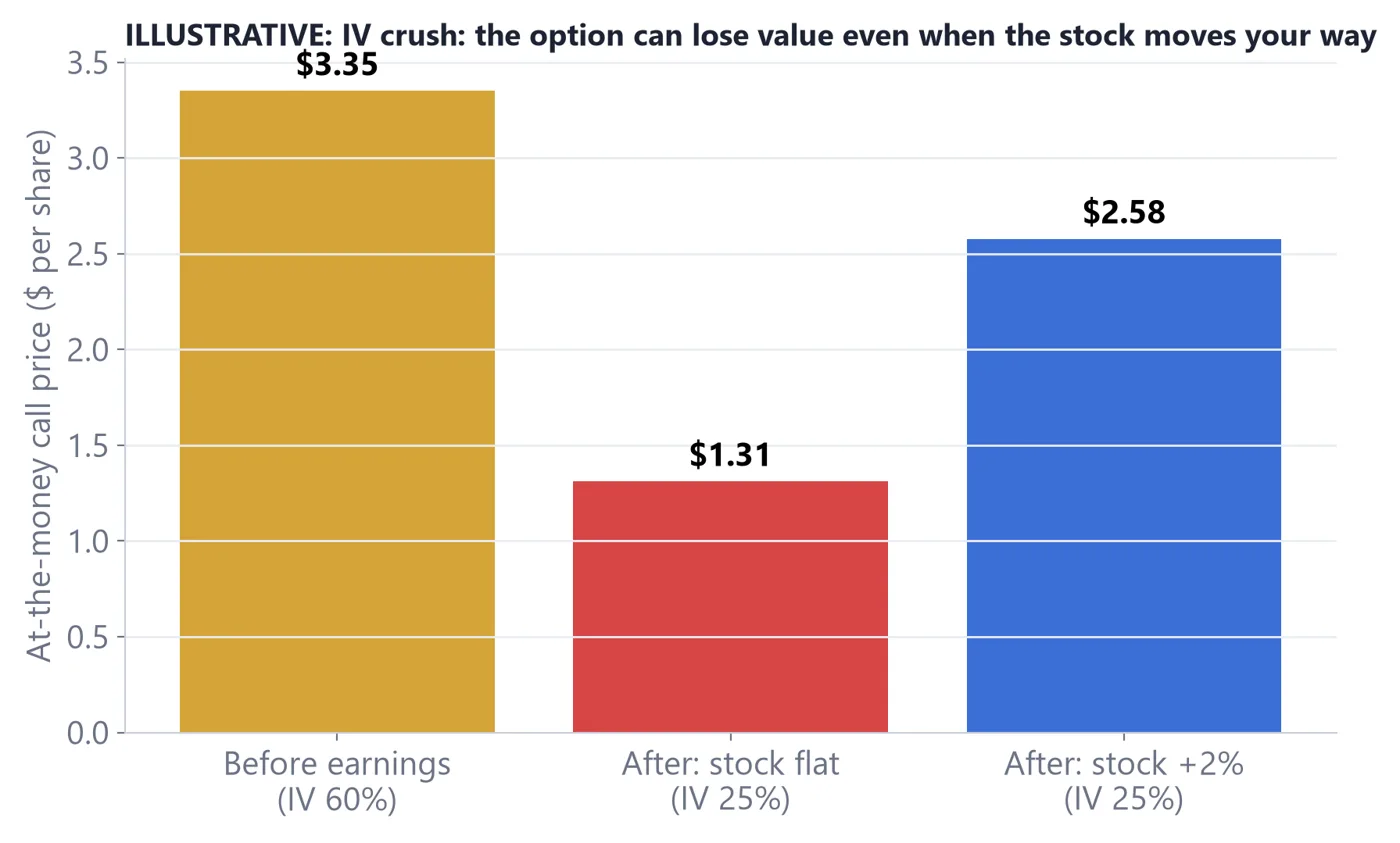
- 1Before the event, IV is high, so time value is inflated.
- 2After the event, IV falls sharply and the time value shrinks, even if the underlying moved.
- 3The final price combines the delta gain from the move and the vega loss from lower IV.
- 4If vega loss is larger than delta gain, the option falls despite a favourable move.
Hypothetical example. A stock trades at 200 the day before earnings. An at-the-money 200 call costs 10.00 with IV at 60%. Assume delta 0.50 and a vega of 0.20 per IV point. The stock rises $4 to 204 after earnings, and IV drops from 60% to 40%, a fall of 20 points. Ignoring theta and gamma to keep the arithmetic simple:
| Effect | Arithmetic | Change per share |
|---|---|---|
| Delta gain | 0.50 x 4 | +2.00 |
| Vega loss | 0.20 x 20 | -4.00 |
| Net | +2.00 - 4.00 | -2.00 |
| New call price | 10.00 - 2.00 | 8.00 |
The call lost 2.00 x 100 = $200 per contract although the stock moved $4 in the buyer's favour. The market had already priced in a big move. The actual move was smaller than what the price implied, so IV deflated. This is the pattern traders mean when they say 'right on direction, wrong on price'.
5.3 Using this knowledge
Understanding IV crush does not tell you what to do. It tells you what to check. Before holding an option through an event, ask: how much move is already priced in? Many platforms show an expected move, an estimate derived from option prices. If your idea needs a move larger than that, you are asking for more than the market expects. If it needs less, you are paying for movement that may not be needed.
Selling options before an event to benefit from IV crush looks attractive in the same way, but the seller takes the risk of the big move. A move larger than the one priced in can cause large losses, especially on undefined-risk positions (Lesson 6). Nothing here is a suggestion to do either; the aim is to know what the price already contains.
- Implied volatility is the market's pricing of expected movement, not of direction.
- IV often rises before a known event and drops after it.
- A favourable move can still lose money if vega loss exceeds delta gain.
- Check how much movement is already priced in before holding through an event.
Quick check
Pass with 2 of 3 to complete the lesson (+20 XP, plus 5 XP per correct answer the first time).
1.What does a high implied volatility tell you?
2.What is IV crush?
3.A call is worth 10.00. The stock gains $3 (delta 0.50) and IV falls 10 points (vega 0.20). Ignoring other effects, the new price is: