Lesson 4 · 9 min
Time decay
You’ll learn
- Why an option loses time value as expiry approaches
- Why decay speeds up in the final weeks
- How decay differs for buyers and sellers, and what that does and does not imply
4.1 Time value is a melting asset
Lesson 1 split an option's premium into intrinsic value and time value. Time value is the price of the chance that the underlying moves further before expiry. On expiry day, no chance is left, so time value is zero. Every day in between, some of it disappears. This steady loss is time decay, measured by theta.
The decay does not happen at an even speed. An option with a long time to run has plenty of room for something to happen, and each passing day takes only a small bite. In the last weeks the remaining chances shrink quickly, and the daily bite grows. At the money, this effect is strongest.
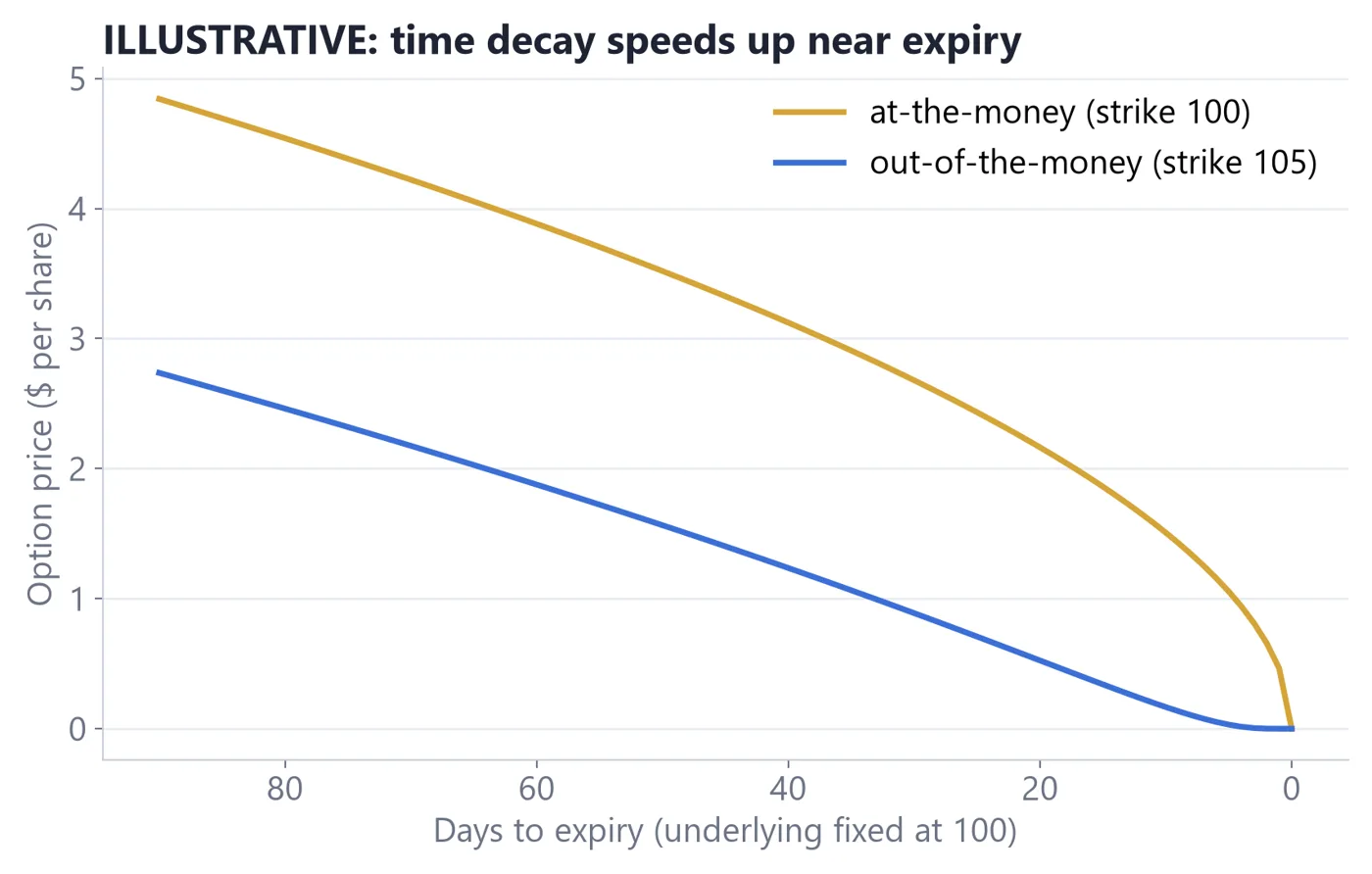
- 1Read the chart right to left: expiry is on the left, 30 days out on the right.
- 2From 30 to 15 days, the line falls gently.
- 3In the last 10 days, the line steepens.
- 4At expiry only intrinsic value remains. For an out-of-the-money option that is zero.
4.2 A worked illustration
Hypothetical example. SPY stays flat at 600 and implied volatility does not change. An at-the-money 600 call is priced like this on the way to expiry (round, illustrative numbers, not market quotes):
| Days left | Call price | Lost from previous row | Per contract |
|---|---|---|---|
| 30 | 4.50 | - | - |
| 15 | 3.20 | 1.30 over 15 days | $130 |
| 5 | 1.90 | 1.30 over 10 days | $130 |
| 1 | 0.90 | 1.00 over 4 days | $100 |
| 0 | 0.00 | 0.90 in the last day | $90 |
Total decay is 4.50 - 0.00 = 4.50 per share, or $450 per contract, which is the entire premium. Notice the rate: roughly 1.30 / 15 = 0.09 per day early on, then 1.30 / 10 = 0.13 per day, then 1.00 / 4 = 0.25 per day, then 0.90 in the last single day. The same dollars leak out of a shrinking window.
4.3 Buyers, sellers and an honest caution
Decay works against option buyers and, in a narrow accounting sense, in favour of option sellers. Because of this, premium selling is sometimes promoted as a way to 'collect income'. This guide does not make that claim. The seller accepts the risk of a large move, and the market tends to price that risk into the premium. Selling an option that expires worthless keeps the premium, but one bad move can cost many times that premium. Whether a given approach has an edge after costs is a question for your own tested data, not a promise from a book.
Short-dated options also carry high gamma. They can change value quickly in either direction, and the bid/ask gap is a bigger share of a small premium. A buyer needs the move to arrive soon and be large enough to beat the decay. This is why picking an expiry that gives your idea time to play out matters as much as picking a strike.
Decay also runs over weekends and holidays in the model, so an option held over a quiet weekend can open Monday with less time value even if the underlying has not moved. Check how your broker counts days to expiry before you compare two expiries.
Hypothetical example that fails. A trader buys a 600 call with 5 days left for 1.90 ($190), expecting a bounce. SPY drifts sideways at 600 for four days, then edges to 601. With 1 day left the call is worth about 1.40 (the intrinsic value is 1.00; some time value remains). The trader has lost 0.50 x 100 = $50 even though SPY ended above the strike. A bounce that comes too late is a missed bounce.
- Time value falls to zero at expiry and falls fastest in the last weeks.
- A buyer needs the move to be big enough and early enough to beat decay.
- Decay benefits sellers on paper, but sellers accept the risk of large moves; it is not guaranteed income.
- Choose an expiry that gives your idea room in time.
Quick check
Pass with 2 of 3 to complete the lesson (+20 XP, plus 5 XP per correct answer the first time).
1.When does time decay of an at-the-money option usually speed up?
2.An option with theta -0.06 held for 3 days (all else equal) loses about how much per contract?
3.Which statement is accurate?