Lesson 3 · 10 min
Delta and the other Greeks in plain English
You’ll learn
- What delta, gamma, theta and vega measure
- How to turn delta into dollars per contract
- Why Greeks are estimates that change as the market moves
3.1 What the Greeks are
The Greeks are measurements of how an option's price is expected to change when one input changes. They come from a pricing model, so they are estimates, and they shift as the market moves. You do not need the maths. You need the meaning.
| Greek | Measures sensitivity to | Plain meaning |
|---|---|---|
| Delta | A 1-point move in the underlying | How much the option price changes for a 1-point move |
| Gamma | Change in delta | How fast delta itself changes |
| Theta | One day passing | How much time value leaks away per day |
| Vega | A 1-point change in implied volatility | How much the price changes if IV rises or falls |
3.2 Delta: the one that matters first
Delta is the expected change in the option price for a 1-point move in the underlying. A call has a delta between 0 and 1. A put has a delta between 0 and -1 (it gains when the price falls). Per contract, multiply delta by the 100 multiplier.
Hypothetical example. A SPY call has a delta of 0.50. If SPY rises 1 point and nothing else changes, the call is expected to gain about 0.50 per share, or 0.50 x 100 = $50 per contract. With 5 contracts at delta 0.30, your position behaves like 5 x 100 x 0.30 = 150 shares of SPY for small moves. That 'share-equivalent' number is useful for comparing an options position with a futures position.
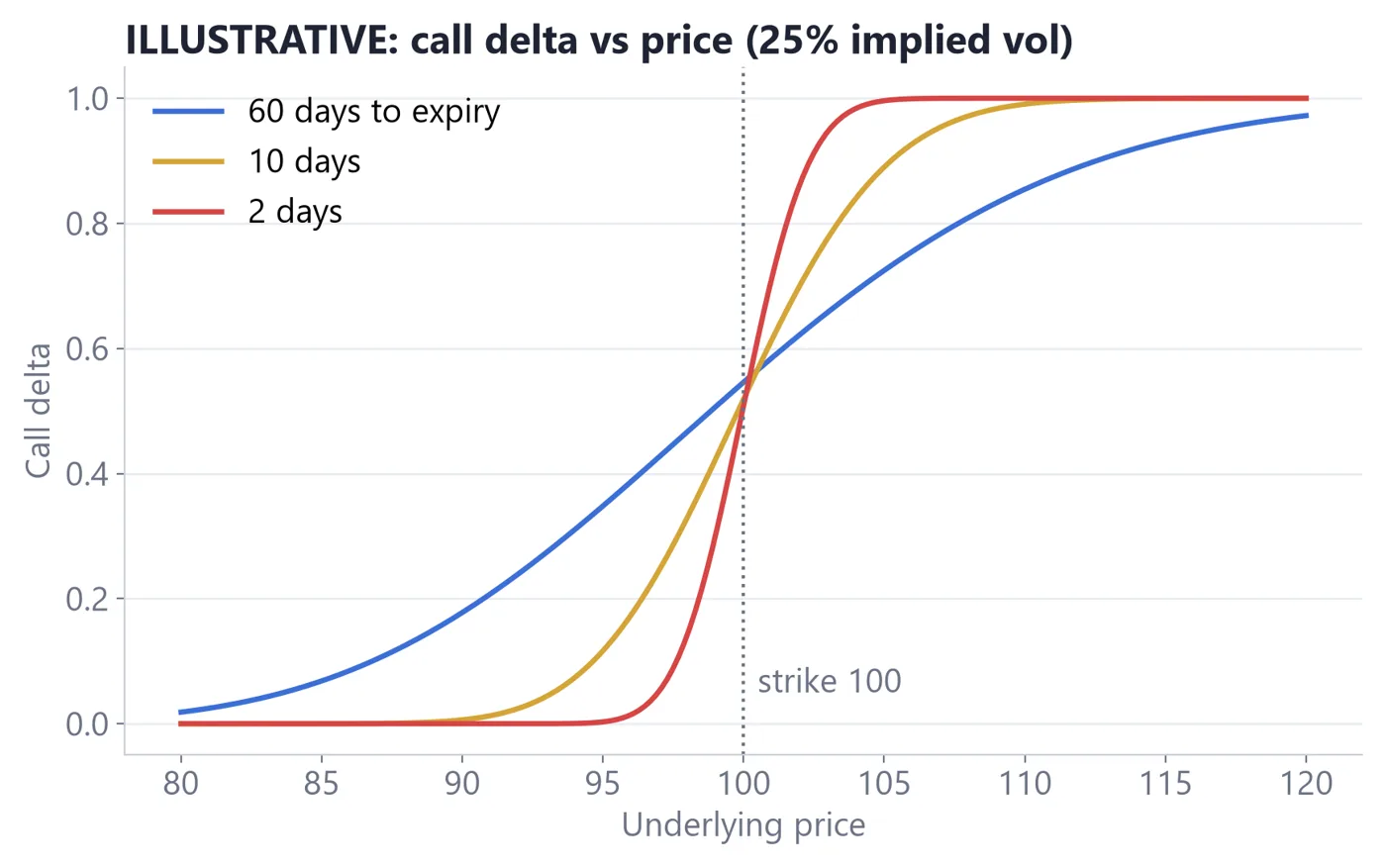
- 1Deep out of the money, delta is near 0: the option barely reacts.
- 2At the money, delta is near 0.50.
- 3Deep in the money, delta approaches 1.00: the option moves almost like the shares.
- 4The curve is steepest near the strike. That steepness is gamma.
A futures trader can compare: one ES future has a delta of 1.0 to its own price. A 0.50-delta ES option behaves roughly like half an ES contract for small moves. That equals about 0.5 x $50 = $25 per index point. This is only an approximation.
3.3 Gamma, theta, vega
Gamma tells you how much delta changes when the underlying moves 1 point. It is largest for at-the-money options near expiry. High gamma means the position's behaviour changes quickly, which can help or hurt.
Theta is the daily cost of holding time value. Hypothetical example. A long option has a theta of -0.05. Each day, with everything else unchanged, it is expected to lose about 0.05 per share, or 0.05 x 100 = $5 per contract per day. Theta is negative for the buyer and works in the opposite direction for the seller. Lesson 4 explains why theta grows near expiry.
Vega measures sensitivity to implied volatility. Hypothetical example. An option has a vega of 0.10. If IV rises by 1 percentage point, the price is expected to rise 0.10 per share, or $10 per contract. If IV falls 5 points, the loss from vega alone is 5 x $10 = $50 per contract. Lesson 5 shows how this can erase a gain.
A loose rule of thumb, sometimes quoted by traders, says an option's delta is a rough guide to the market-implied chance of finishing in the money. Treat that as a heuristic only. It is model-based, not a prediction, and it says nothing about what will actually happen.
Putting the four together: a trader looking at a chain should read delta for direction exposure, gamma for how unstable that exposure is, theta for the daily cost of waiting, and vega for how much a change in nervousness matters. Two options with the same delta can behave very differently if one expires tomorrow and the other in three months.
- Delta is the expected option price change for a 1-point move; multiply by 100 for dollars per contract.
- Delta times 100 times contracts gives share-equivalent exposure.
- Theta is the daily time cost and vega is sensitivity to implied volatility.
- All Greeks are model estimates and they change constantly.
Quick check
Pass with 2 of 3 to complete the lesson (+20 XP, plus 5 XP per correct answer the first time).
1.A call has delta 0.40. SPY rises 2 points, all else equal. What is the expected change for one contract?
2.Which Greek describes the daily cost of holding an option as time passes?
3.Which is the safest description of Greeks?