Lesson 1 · 9 min
What an option is
You’ll learn
- What a call, a put, a strike, an expiry and a premium are
- Why one SPY or QQQ option controls 100 shares (the multiplier)
- How to read the rows of an option chain, and how options on futures differ
1.1 A contract with a deadline
A futures trader already understands one kind of contract: an obligation to buy or sell something at a set price later. An option is different in one key way. It gives the buyer a right, not an obligation. The buyer pays a price for that right, and the right expires on a set date.
A call option gives the buyer the right to buy the underlying at a fixed price. A put option gives the buyer the right to sell the underlying at a fixed price. The fixed price is the strike. The last day the right exists is the expiry (or expiration date). The price the buyer pays up front is the premium. The underlying here is a fund such as SPY (tracks the S&P 500) or QQQ (tracks the Nasdaq-100).
The seller (also called the writer) takes the other side. The seller collects the premium and accepts the obligation if the buyer uses the right. That is why the two sides are not mirror images in risk. A buyer can lose at most the premium paid. A seller of some options can lose far more than the premium collected. Lesson 6 returns to this.
1.2 The multiplier: 100 shares per contract
Option prices are quoted per share, but one standard SPY or QQQ contract covers 100 shares. That number is the multiplier. To find the cash cost, multiply the quoted premium by 100.
Hypothetical example. SPY trades at 600 (a round placeholder, not a real quote). A call with a 600 strike is quoted at 4.50. The cost is 4.50 x 100 = $450 for one contract. If the quote were 0.45, the cost would be 0.45 x 100 = $45. Quotes that look small can still be real money once the multiplier is applied.
| Term | Plain meaning | Hypothetical value |
|---|---|---|
| Underlying | The thing the option is based on | SPY at 600 |
| Strike | The fixed price in the contract | 600 |
| Expiry | Last day the right exists | 30 days from now |
| Premium | Price per share, paid by the buyer | 4.50 |
| Multiplier | Shares per contract | 100 |
| Cost of 1 contract | Premium x multiplier | 4.50 x 100 = $450 |
1.3 Reading an option chain
An option chain is the menu of every strike and expiry for one underlying. Calls usually sit on one side and puts on the other. Each row is a strike. Each strike shows a bid (the best price a buyer is offering), an ask (the best price a seller wants), the volume traded today, the open interest (contracts still open), the implied volatility (IV, covered in Lesson 5) and often the delta (Lesson 3).
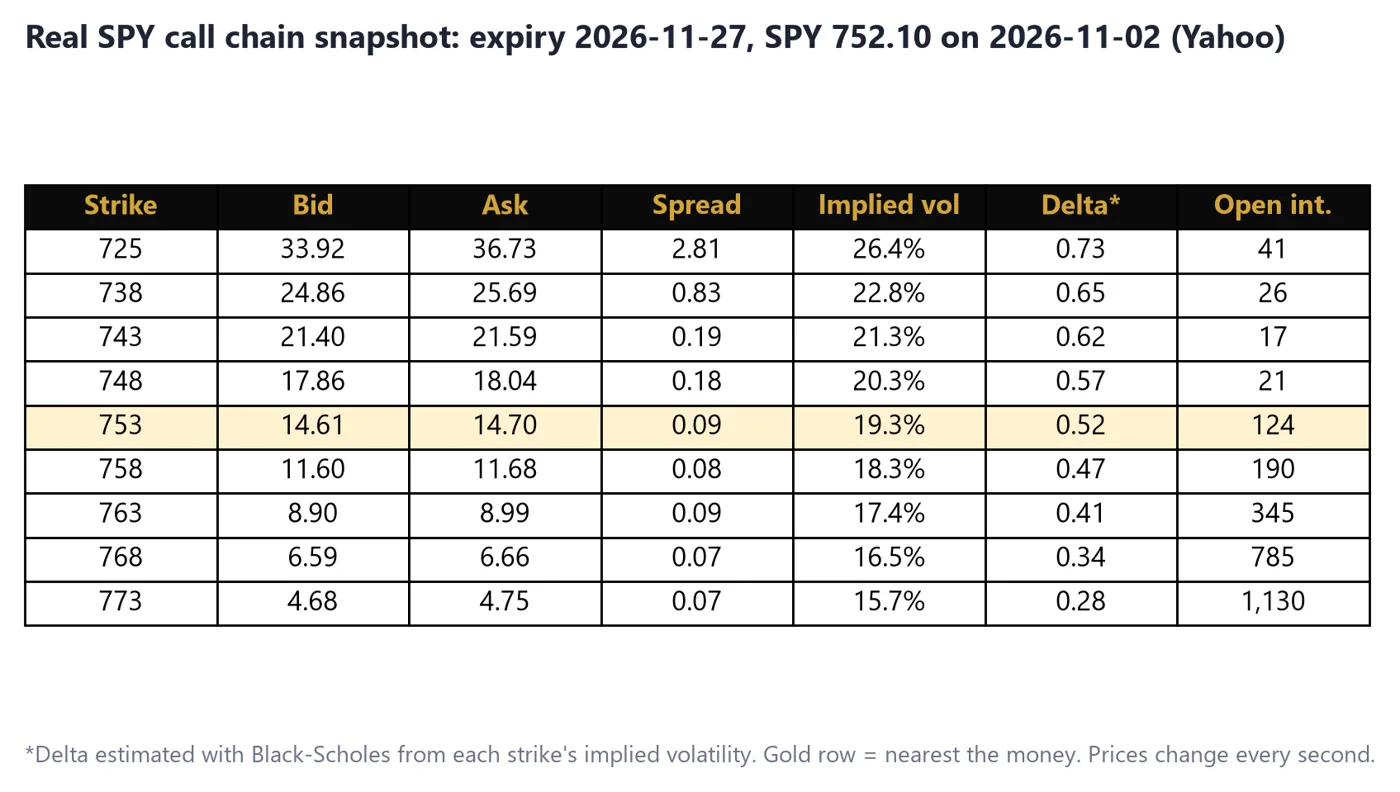
- 1Each row is one strike. Find the row nearest the current SPY price: that is 'at the money'.
- 2Bid is what you could sell for now. Ask is what you would pay to buy now. The gap between them is a cost.
- 3Calls with strikes below the price, and puts with strikes above it, are 'in the money' and already hold intrinsic value.
- 4Delta and IV columns are estimates from a model, not guarantees.
Two words come up constantly. In the money (ITM) means the option would have value if it expired right now: a call with the strike below the price, or a put with the strike above it. Out of the money (OTM) is the opposite. At the money (ATM) means the strike is close to the current price. An option's premium has two parts: intrinsic value (how far it is in the money, if at all) and time value (what the market charges for the chance of more movement before expiry).
1.4 Options on futures, briefly
Options also exist on futures, such as options on E-mini S&P 500 (ES) futures. The structure is the same, but the underlying is a futures contract and the multiplier is different. ES futures are worth $50 per index point, so an ES option's premium is also multiplied by $50. Hypothetical example: an ES option quoted at 40 points costs 40 x $50 = $2,000. A SPY option quoted at 4.50 costs $450. Always check the multiplier of the exact product on your broker's contract specifications page before you compare costs. Exercising an option on a future results in a futures position, not shares.
1.5 American and European style
SPY and QQQ options are American style: the holder may exercise on any trading day up to expiry. Some index options are European style: exercise only at expiry. This matters mainly for people who sell options, because an American-style option they sold can be exercised against them early (Lesson 6).
- A call is the right to buy and a put is the right to sell at a fixed strike before expiry.
- Premium is quoted per share; multiply by 100 for SPY or QQQ contracts.
- An option's price is intrinsic value plus time value.
- Options on futures use the futures multiplier (for ES, $50 per point); always check the contract specifications.
Quick check
Pass with 2 of 3 to complete the lesson (+20 XP, plus 5 XP per correct answer the first time).
1.A call is quoted at 2.30 on SPY. What does one standard contract cost before fees?
2.What does a put option give its buyer?
3.An ES option quoted at 10 points, with a $50 multiplier, costs about: