Lesson 3 · 10 min
Margin, leverage and losing more than your deposit
You’ll learn
- The difference between initial margin, maintenance margin and day-trade margin
- What a margin call is and how leverage magnifies gains and losses
- How a 1% risk rule keeps position size sane, and why losses can exceed your deposit
3.1 Margin is a deposit, not a down payment
Margin in futures is a good-faith deposit. It is not a loan to buy the contract and it is not a fee. It is money set aside in your account to show you can cover losses. The amount is a small slice of the contract's notional value, which is why futures are called a leveraged product.
Initial margin is the amount needed to open a position and hold it overnight. Maintenance margin is the minimum balance you must keep while the position is open. If your account equity falls below maintenance margin, you may get a margin call, a demand to add money or reduce the position. Brokers can also close positions without asking.
Many brokers also offer day-trade margin (also called intraday margin). It is a much lower requirement that applies only if you close the position before the session ends. It varies a lot by broker, and brokers can change it, even raise it quickly in fast markets. The exchange sets the base requirement and the broker may ask for more. Always read your own broker's current margin page.
The numbers in this lesson are hypothetical. Do not treat them as current requirements.
3.2 Leverage works in both directions
Leverage means a small amount of money controls a large position. Hypothetical example: ES is at 5,000, so one contract has a notional value of $250,000. Suppose initial margin is $12,000. Leverage is about $250,000 / $12,000 = 20.8 to 1.
Now watch what a 1% move does. 1% of 5,000 is 50 points. 50 points x $50 = $2,500. If your account holds $15,000, a 1% market move equals $2,500 / $15,000 = 16.7% of your account. The same arithmetic works for gains and for losses. Leverage does not change the odds. It changes the size of the swing.
Hypothetical example (margin call): you have $15,000 and hold 1 ES. Suppose maintenance margin is $11,000. Price falls 90 points. 90 x $50 = $4,500 loss. Your equity is now $15,000 - $4,500 = $10,500, which is below $11,000. You may receive a margin call, or the broker may close the trade for you, locking in the loss.
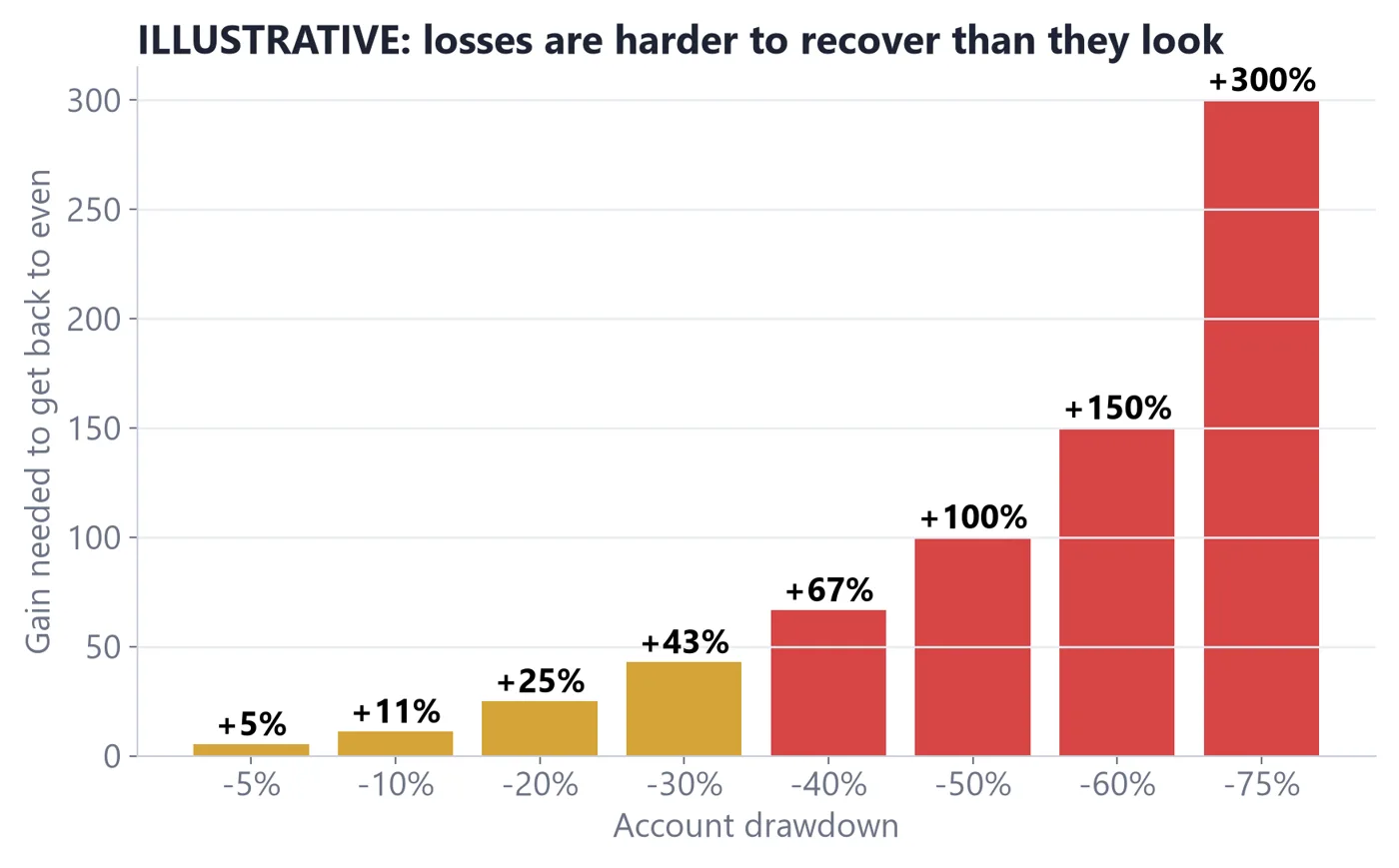
- 1A 10% loss needs about an 11% gain to get back to even.
- 2A 50% loss needs a 100% gain.
- 3Big leveraged losses are hard to climb out of, which is why keeping each loss small matters.
3.3 Losing more than you deposited
In futures it is possible to lose more than the money in your account. This is the point many beginners miss. If the market gaps, jumps past your stop, or trades with no buyers, your loss can exceed your balance and you may owe the broker the difference.
Hypothetical example: a $5,000 account holds 1 ES over a news event. Price gaps 150 points against the position. 150 x $50 = $7,500. The account goes to $5,000 - $7,500 = -$2,500. The trader owes $2,500, and the stop order did not help because price jumped over it. A stop is not a promise of a price. A gap is the exact moment it cannot be.
A small account with a full-size contract is the easiest way to end up here. The cure is not clever stops. It is smaller size. Tie your size to a fixed fraction of the account, such as the 1% teaching guideline from Supplement 5 (Psychology & Risk Management). With a $15,000 account, 1% is $150. A hypothetical MES stop of 30 points is 30 x $5 = $150 per contract. So the plan allows 1 MES. Compare that to 1 ES at the same stop: 30 x $50 = $1,500, which is 10% of the account and ten times the plan.
Notice that margin is not part of the sizing formula. Your margin tells you what the broker allows. Your risk rule tells you what you should allow yourself. They are different numbers, and the second one is usually much smaller.
- Margin is a good-faith deposit, not a loan and not a fee; day-trade margin varies by broker and can change.
- Leverage magnifies gains and losses equally: 1% on ES at 5,000 is $2,500 per contract.
- A gap can push losses past your account balance; a stop does not fix your fill price.
- Size from your risk rule (such as 1%, a teaching guideline), not from the maximum your broker allows.
Quick check
Pass with 2 of 3 to complete the lesson (+20 XP, plus 5 XP per correct answer the first time).
1.What is maintenance margin?
2.Why can you lose more than your deposit in futures?
3.Account $15,000, 1% risk, MES stop of 30 points ($5 per point). How many contracts does the plan allow?