Lesson 4 · 9 min
Sessions, rollover and the calendar
You’ll learn
- How the nearly 24-hour session, the daily maintenance break and the regular session fit together
- What roll week is and how volume shifts to the next contract
- How economic releases, price limits and halts affect trading, in plain terms
4.1 The nearly 24-hour day
Equity index futures trade on an electronic platform that is open almost around the clock from Sunday evening to Friday afternoon. Stocks, by contrast, trade mainly from 9:30 am to 4:00 pm Eastern Time (ET). That daytime window is called the regular session or regular trading hours (RTH). The rest of the time is the overnight or extended session.
The most commonly quoted schedule for CME equity index futures is a one-hour daily maintenance break in the late afternoon, around 5:00 pm to 6:00 pm ET, when trading pauses. Check the CME Group website for the current times, because holidays and special days change the schedule.
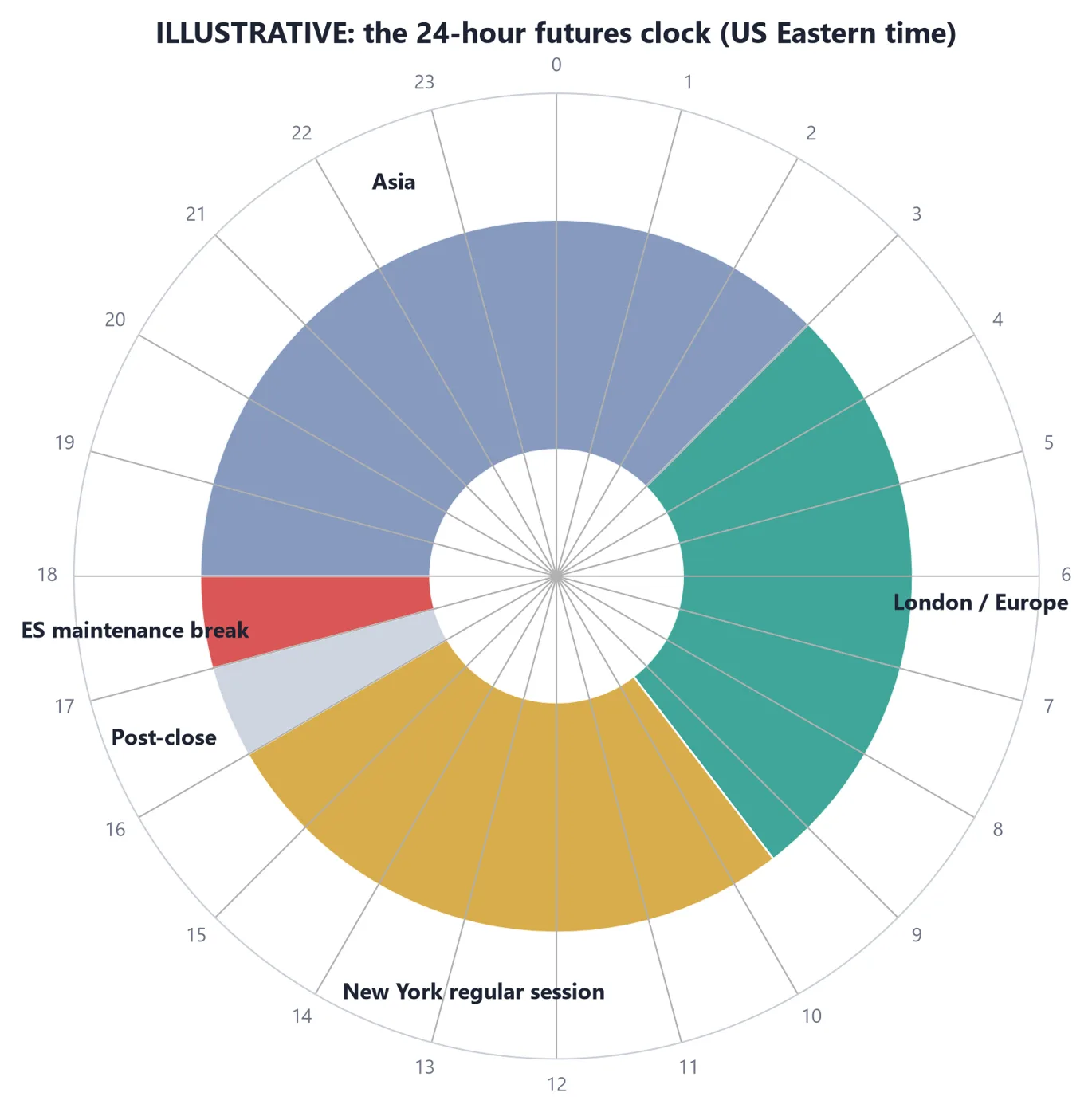
- 1Asia and London trade while many US traders are asleep. Volume is usually lighter then.
- 2The New York regular session at 9:30 am ET is when volume usually picks up most.
- 3The short maintenance break splits one trading day from the next.
Liquidity changes through the day. Liquidity means how easily you can buy or sell without moving the price. Overnight, fewer orders are in the market, so the gap between the best bid and ask can widen, and prices can jump on thin trading. Some traders prefer the regular session for that reason. This is a feature of the market, not a rule.
4.2 Roll week
Because each contract expires, the market must move its trading to the next month. This happens gradually. For equity index futures, many traders move from the expiring contract to the next one about a week or so before expiry. In those days, trading volume (how many contracts change hands) falls in the old contract and rises in the new one. The period is often called roll week.
The front month is the nearest expiry. As volume shifts, the next month becomes the most active one. Most traders follow the contract with the most volume, since that is where the tightest spreads and easiest fills are. Check the volume of both contracts in your platform before you decide.
To roll a position you sell the old contract and buy the new one, or the reverse for a short. The two prices are not identical. The difference is the calendar spread. Hypothetical example: you are long 1 ESZ6 and ESZ6 trades at 5,000.00 while ESH7 trades at 5,030.00. You close ESZ6 at 5,000.00 and buy ESH7 at 5,030.00. Your chart now shows a 30-point jump that is not a market move. It is the difference between two contracts. Continuous charts such as ES1! handle this by stitching, which is why they can show gaps at the roll.
Hypothetical example (skipped roll): you hold 1 CL into the last days before expiry. Your plan was to close the trade, but the position has a profit and you do not want to exit. The broker's rule says positions must be closed or rolled by a set time or they will be liquidated. You decide to skip the extra hold, close it and re-enter in the next month only if the setup is still valid. Following the broker's deadline over your wish to keep a winner is the plan working.
4.3 The calendar, limits and halts
Scheduled economic releases can move futures sharply. In the United States, many traders mark the 8:30 am ET reports such as the monthly jobs report (usually the first Friday of the month) and the consumer price index (CPI), and the Federal Reserve's interest-rate announcements, usually at 2:00 pm ET. Right before and after a release, spreads can widen and price can move fast in both directions. Some traders reduce size or stay out around them. That is a choice, not a rule.
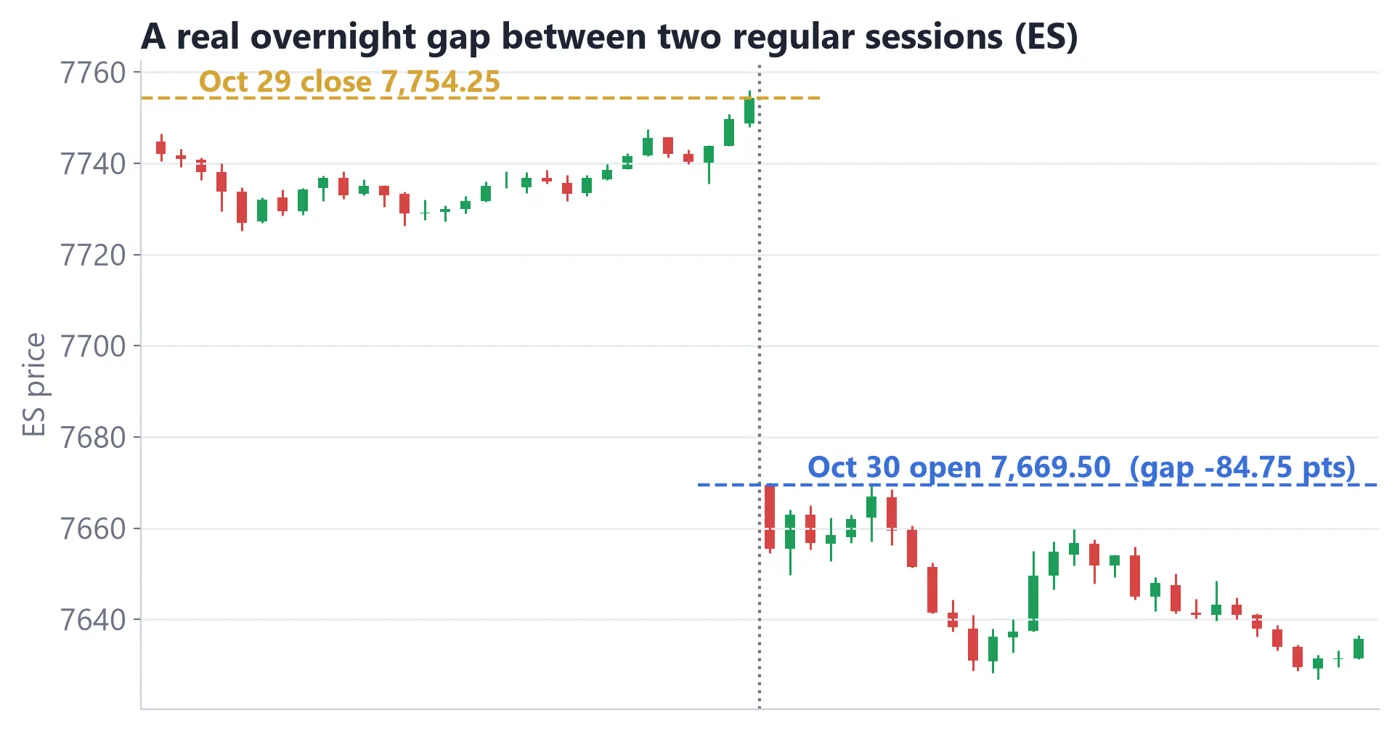
- 1The gap is the empty space between the prior close and the new open.
- 2Futures can gap after news released during the overnight session.
- 3A stop order sitting inside a gap cannot fill inside it.
Exchanges also put brakes on extreme moves. A price limit is a boundary, set relative to the prior day's settlement price, beyond which the exchange does not allow trades. In plain terms: when price touches the limit, trading continues only at or inside it, and a halt pauses trading for a short time. Equity index futures also follow market-wide circuit breakers linked to big drops in the S&P 500. The exact levels and rules change, so read the exchange's current rules.
What does this mean for you? If a market is limit-locked or halted, you may not be able to exit at all until trading resumes. Your loss can continue to grow while you are locked in. That is another reason to size positions small.
- Futures trade nearly 24 hours with a short daily maintenance break; check CME for current times.
- The regular session (9:30 am to 4:00 pm ET) is usually the busiest; overnight liquidity is thinner.
- Around roll week, volume moves to the next contract; follow the more active one and watch your broker's deadline.
- Economic releases, price limits and halts can widen spreads or stop trading; plan size and timing around them.
Quick check
Pass with 2 of 3 to complete the lesson (+20 XP, plus 5 XP per correct answer the first time).
1.What is roll week?
2.Why can a stop order fail to fill at your price across a gap?
3.You close ESZ6 at 5,000.00 and open ESH7 at 5,030.00 to roll a long. What is the 30-point difference?