Lesson 2 · 10 min
Contract specs and tick maths
You’ll learn
- What a tick, a point and a tick value are
- The specs for ES, MES, NQ, MNQ, CL and GC
- How to turn a price move into dollars, and a contract into notional value
2.1 Ticks, points and dollars
Prices on a futures market move in fixed steps. The smallest step is the tick. The tick size is how far price moves in one tick, and the tick value is how many dollars one tick is worth for one contract. A point is a bigger unit, usually a whole number on the price, and the point value is the dollars per point.
For ES the tick size is 0.25 index points and the tick value is $12.50. There are four ticks in a point, so the point value is 4 x $12.50 = $50. If ES moves from 5,000.00 to 5,001.00, that is 4 ticks, or one point, and one contract gains or loses $50.
Always check the official contract specification on the exchange website before you trade. Specs can change, and the numbers below are the ones this guide uses for teaching.
| Contract | Underlying | Tick size | Tick value | Point value |
|---|---|---|---|---|
| ES | E-mini S&P 500 | 0.25 | $12.50 | $50 |
| MES | Micro E-mini S&P 500 | 0.25 | $1.25 | $5 |
| NQ | E-mini Nasdaq-100 | 0.25 | $5.00 | $20 |
| MNQ | Micro E-mini Nasdaq-100 | 0.25 | $0.50 | $2 |
| CL | Crude oil (1,000 barrels) | 0.01 | $10 | $1,000 |
| GC | Gold (100 troy ounces) | 0.10 | $10 | $100 |
Notice that the micros are one tenth the size of their full-size cousins. MES is one tenth of ES, and MNQ is one tenth of NQ. That makes micros a way to take smaller risk while you learn.
2.2 Worked tick maths
The method is the same for every market: move in ticks x tick value x number of contracts. Here are four hypothetical examples. All prices are made up for teaching.
Hypothetical example, ES: a long position moves from 5,000.00 to 5,007.50. That is 7.50 points, or 7.50 / 0.25 = 30 ticks. 30 x $12.50 = $375. Check by points: 7.5 x $50 = $375.
Hypothetical example, MNQ: price falls 20 points against a long position. 20 / 0.25 = 80 ticks. 80 x $0.50 = $40 per contract. With 3 contracts the loss is 3 x $40 = $120. Check by points: 20 x $2 = $40.
Hypothetical example, CL: crude moves 0.35 against you. 0.35 / 0.01 = 35 ticks. 35 x $10 = $350 per contract. A move of a full dollar in crude is 100 ticks, or $1,000. Oil is a fast market for its size.
Hypothetical example, GC: gold rises 5.00. 5.00 / 0.10 = 50 ticks. 50 x $10 = $500 per contract. Check by points: 5 x $100 = $500.
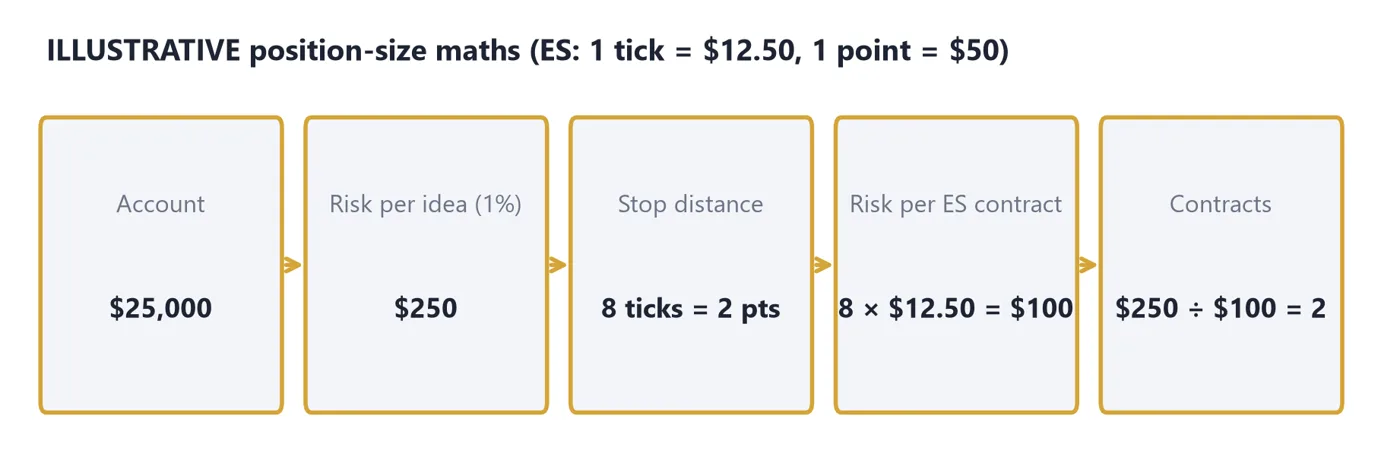
- 1Start with the dollars you are willing to lose on the trade.
- 2Convert your stop distance into ticks, then into dollars per contract.
- 3Divide the first number by the second and round down to a whole number of contracts.
2.3 Notional value, and a skipped trade
Notional value is the full value of what the contract controls: price x point value. Hypothetical example: if ES is at 5,000, one contract controls 5,000 x $50 = $250,000 of index exposure. One MES controls 5,000 x $5 = $25,000. If NQ is at 18,000, one contract controls 18,000 x $20 = $360,000, and one MNQ controls $36,000. A crude contract at $70 controls 70 x $1,000 = $70,000.
Notional value matters because your profit and loss follow the full amount, not the small deposit you put down. Lesson 3 covers that deposit. Here, just notice that a single contract can control a very large number.
Hypothetical example (skipped trade): your account is $5,000 and your plan risks 1%, which is $50. You spot a setup on MES with a stop 12 points away. 12 points = 48 ticks. 48 x $1.25 = $60 for one contract. Because $60 is more than your $50 limit, even one contract breaks the plan. A trader who follows the plan skips the trade or finds a tighter, still logical stop. Taking one contract anyway and calling it close enough is how risk rules quietly break.
- Move in ticks x tick value x contracts equals the dollar result.
- ES $12.50, MES $1.25, NQ $5.00, MNQ $0.50, CL $10 and GC $10 per tick; always confirm on the exchange site.
- Notional value (price x point value) shows how much the contract really controls.
- If the stop in dollars is bigger than your risk limit even for one contract, skipping the trade is the plan working.
Quick check
Pass with 2 of 3 to complete the lesson (+20 XP, plus 5 XP per correct answer the first time).
1.ES moves 6 points. How many ticks is that, and what is one contract worth?
2.What is the tick value of one MNQ contract?
3.Crude oil (CL) moves 0.20. What is one contract worth?