Lesson 1 · 9 min
What a futures contract is
You’ll learn
- What a futures contract is and why it is standardised
- How to read expiry months and codes such as ESZ6
- Cash versus physical settlement, and why most retail traders close or roll before expiry
1.1 A standard promise
A futures contract is an agreement to buy or sell a set amount of something at a price agreed today, with the exchange of money and goods happening on a set future date. The thing being traded is called the underlying. It might be a stock index, crude oil, gold or a currency.
Futures began as a tool for businesses. A farmer wants to lock in a selling price before harvest. A bakery wants to lock in a buying price for wheat. Each side agrees a price now so that neither is surprised later. Speculators, including retail traders, take the other side of these agreements. They are not trying to own wheat or oil. They are trying to profit from the price moving.
The key idea is standardisation. Every contract of the same type is identical: same size, same quality, same expiry date, same rules. Because all ES contracts for one month are interchangeable, buyers and sellers can find each other quickly, and the price you see is the price for a known product. An exchange (for example CME Group in the United States) runs the market, and a clearing house stands between every buyer and seller so each side only has to trust the clearing house.
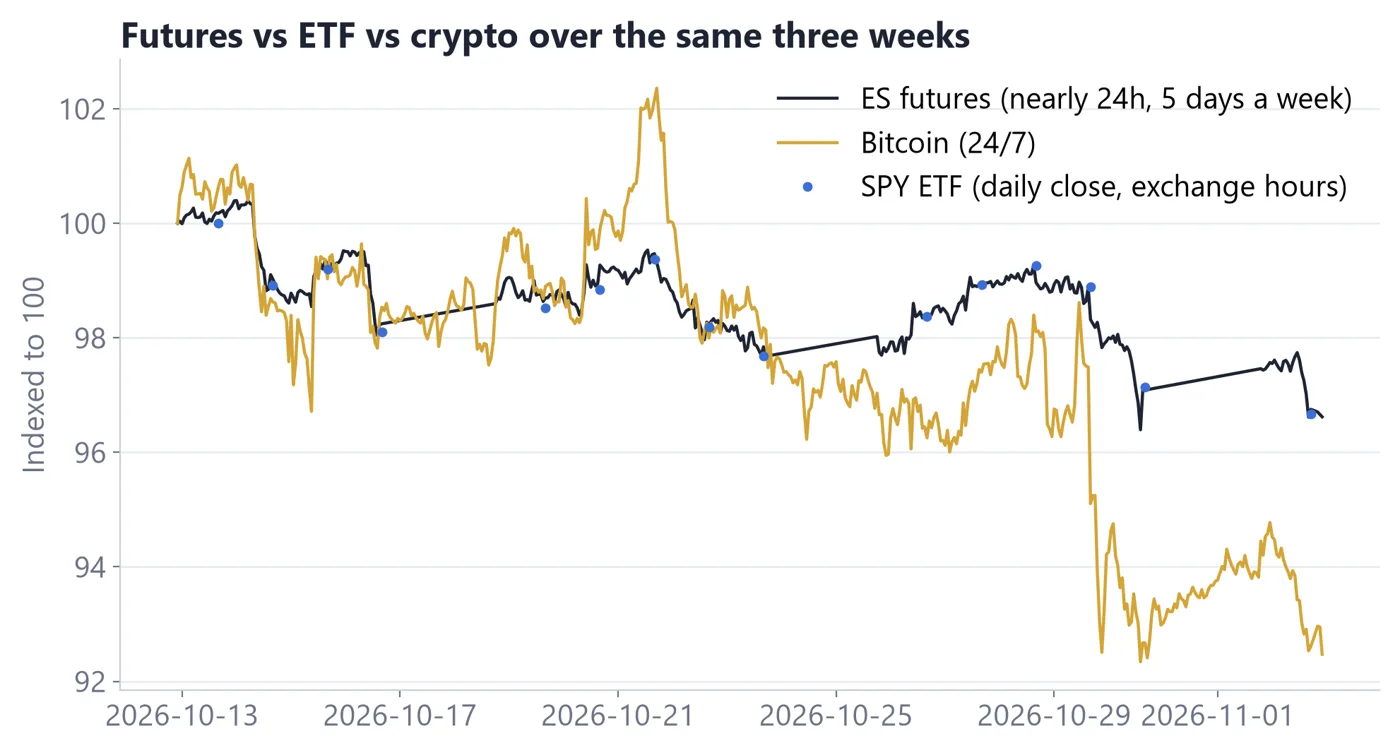
- 1ES is a futures contract on the S&P 500 index. SPY is an exchange-traded fund, a basket of shares.
- 2The two track the same index closely, but they are different products with different rules.
- 3Bitcoin trades all day, every day. Futures trade almost all day, with a short daily break.
1.2 Reading a contract code
Each contract has a code made of three parts: the root symbol for the product, a month letter, and a year digit. Take ESZ6. ES is the E-mini S&P 500. Z is the month, December. 6 is the year, 2026. So ESZ6 is the E-mini S&P 500 contract that expires in December 2026.
The month letters are fixed by the industry. Equity index futures such as ES and NQ expire only in four months: March, June, September and December. They are called the quarterly cycle. Other markets, such as crude oil, have a contract for almost every month.
| Letter | Month | Letter | Month |
|---|---|---|---|
| F | January | N | July |
| G | February | Q | August |
| H | March | U | September |
| J | April | V | October |
| K | May | X | November |
| M | June | Z | December |
A chart labelled ES1! on TradingView is a stitched series of the front (nearest) contract, so it is a convenient chart but not a single tradable contract. When you place an order, you must pick a specific month, such as ESZ6 or ESH7 (March 2027). Picking the wrong month is a common beginner slip, so read the code before every order.
1.3 Settlement and why most close or roll
Settlement is what happens when a contract reaches its expiry. There are two kinds. With cash settlement, no goods change hands. The exchange compares your entry price to a final settlement price and moves the difference in cash. ES and NQ are cash settled. With physical settlement, the real thing is delivered. Crude oil (CL) and gold (GC) are physically settled, which means an unclosed position near expiry can lead to a delivery process that a retail account is not set up for.
Most brokers protect you from this. They set a deadline well before expiry and may close your position automatically, sometimes with a fee, and they can do so at a price you would not choose. The practical rule for retail traders is simple: do not carry a position into expiry unless you have read your broker's rules and fully understand them.
That is why most retail traders either close the position before expiry or roll it. Rolling means closing the expiring contract and opening the same position in the next month. Lesson 4 covers roll week in detail. For now, remember that every futures position has a clock on it, and the clock is the expiry date.
Hypothetical example: you buy 1 ES at 5,000.00 and later sell it at 5,010.00. The move is 10 points. Each ES point is worth $50, so the gross result is 10 x $50 = $500 before fees. Nothing was delivered and you never needed to wait for expiry. You simply closed the trade. That is how the great majority of retail futures trades end.
- A futures contract is a standardised agreement; the exchange and clearing house make every contract of a type identical.
- A code has three parts: product, month letter and year digit. ESZ6 is the E-mini S&P 500 for December 2026.
- ES and NQ settle in cash; CL and GC settle physically, so know the settlement type before trading.
- Every position has an expiry clock. Close or roll before your broker's deadline unless you fully understand the process.
Quick check
Pass with 2 of 3 to complete the lesson (+20 XP, plus 5 XP per correct answer the first time).
1.What does the code ESZ6 mean?
2.Which statement about settlement is correct?
3.Why do most retail traders close or roll before expiry?