WHITE FEATHER FINANCE · FREE DOWNLOAD
Candlestick
Cheat Sheet
12 patterns, real SPY examples, and why context matters more than the shape.
1Hammer
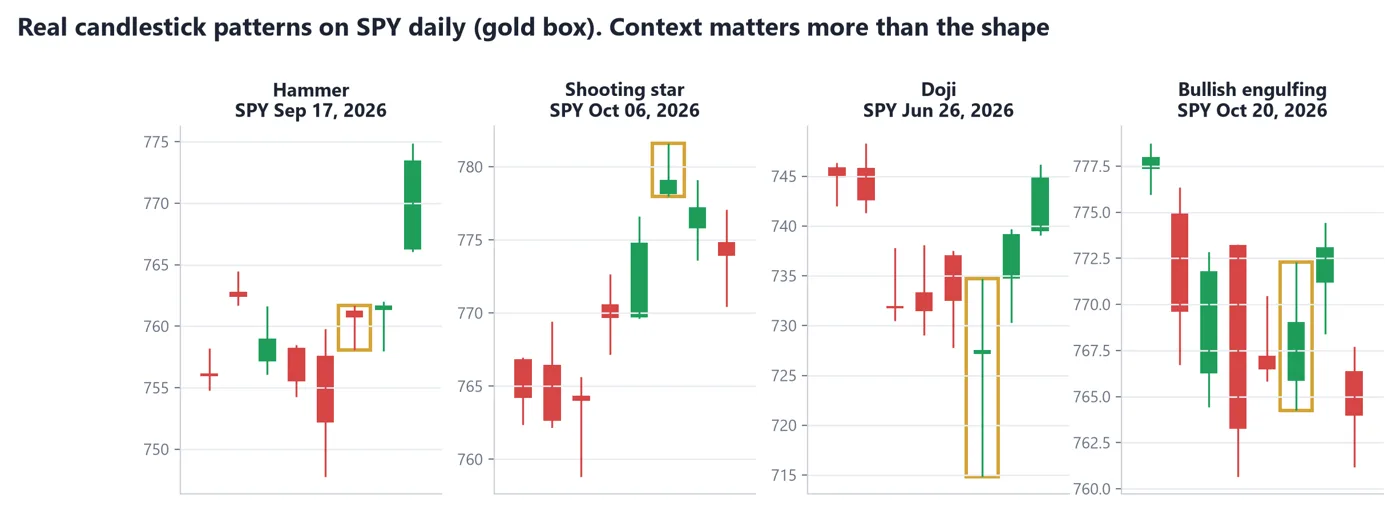
Looks likeA small body near the top of the candle with a long lower wick (at least about twice the body) and little or no upper wick.
Context mattersOften discussed after a decline near a support level, where sellers pushed price down and buyers pushed it back. In the middle of a drift it means little.
Common mistakeBuying every hammer as a reversal signal without a level, a stop or any other evidence.
2Hanging man
Looks likeThe same shape as a hammer (small body, long lower wick) but after an advance.
Context mattersSeen near highs or resistance as a possible sign that sellers are testing. It needs confirmation from later candles.
Common mistakeShorting on the shape alone. The next candle can simply continue higher.
3Shooting star
Looks likeA small body near the bottom with a long upper wick and little lower wick, after an advance.
Context mattersSome traders watch it near resistance, where buyers pushed price up and sellers pushed it back.
Common mistakeTreating it as a sell signal on any chart location.
4Inverted hammer
Looks likeA small body near the bottom with a long upper wick, after a decline.
Context mattersLooks like a shooting star but appears after a fall. Often needs the next candle to close higher before it is taken seriously.
Common mistakeBuying before any follow-through shows up.
5Bullish engulfing
Looks likeA small down candle followed by a larger up candle whose body covers the prior body.
Context mattersMore meaningful after a pullback to a level, and when the larger candle closes strongly. Volume can add context.
Common mistakeIgnoring where it appears. Inside a range it is common and often fails.
6Bearish engulfing
Looks likeA small up candle followed by a larger down candle whose body covers the prior body.
Context mattersMore meaningful near resistance after an advance. It describes a shift in control for that period only.
Common mistakeShorting automatically without a stop above the pattern.
7Doji
Looks likeOpen and close nearly equal, so the body is a thin line, with wicks on one or both sides.
Context mattersIndecision. Its meaning depends on what came before and the nearby levels. After a long move it may mark a pause; in a range it is common.
Common mistakeReading it as a reversal signal by itself.
8Morning star
Looks likeThree candles: a long down candle, a small-bodied candle that gaps or stays low, then a long up candle that closes well into the first candle's body.
Context mattersDiscussed near support after a decline. Because it needs three candles, it is slow and the entry may be far from the low.
Common mistakeForgetting the stop distance: the pattern's low is often far from the entry.
9Evening star
Looks likeThree candles: a long up candle, a small-bodied candle near the top, then a long down candle that closes well into the first body.
Context mattersDiscussed near resistance after an advance. Like the morning star, it is a slow pattern.
Common mistakeTreating it as a prediction of a major top.
10Harami
Looks likeA large candle followed by a small candle whose body is contained inside the large one's body.
Context mattersSignals a pause after a strong move. Direction of the next move is not determined by the shape.
Common mistakeAssuming it always means reversal. It also appears before continuation.
11Marubozu
Looks likeA candle with a long body and little or no wicks. It opens near one extreme and closes near the other.
Context mattersShows one side dominated the period. After a long run it can also be a climactic move. Look at volume and location.
Common mistakeChasing it. Entering after a big candle means a wide stop or a poor reward-to-risk.
12Spinning top
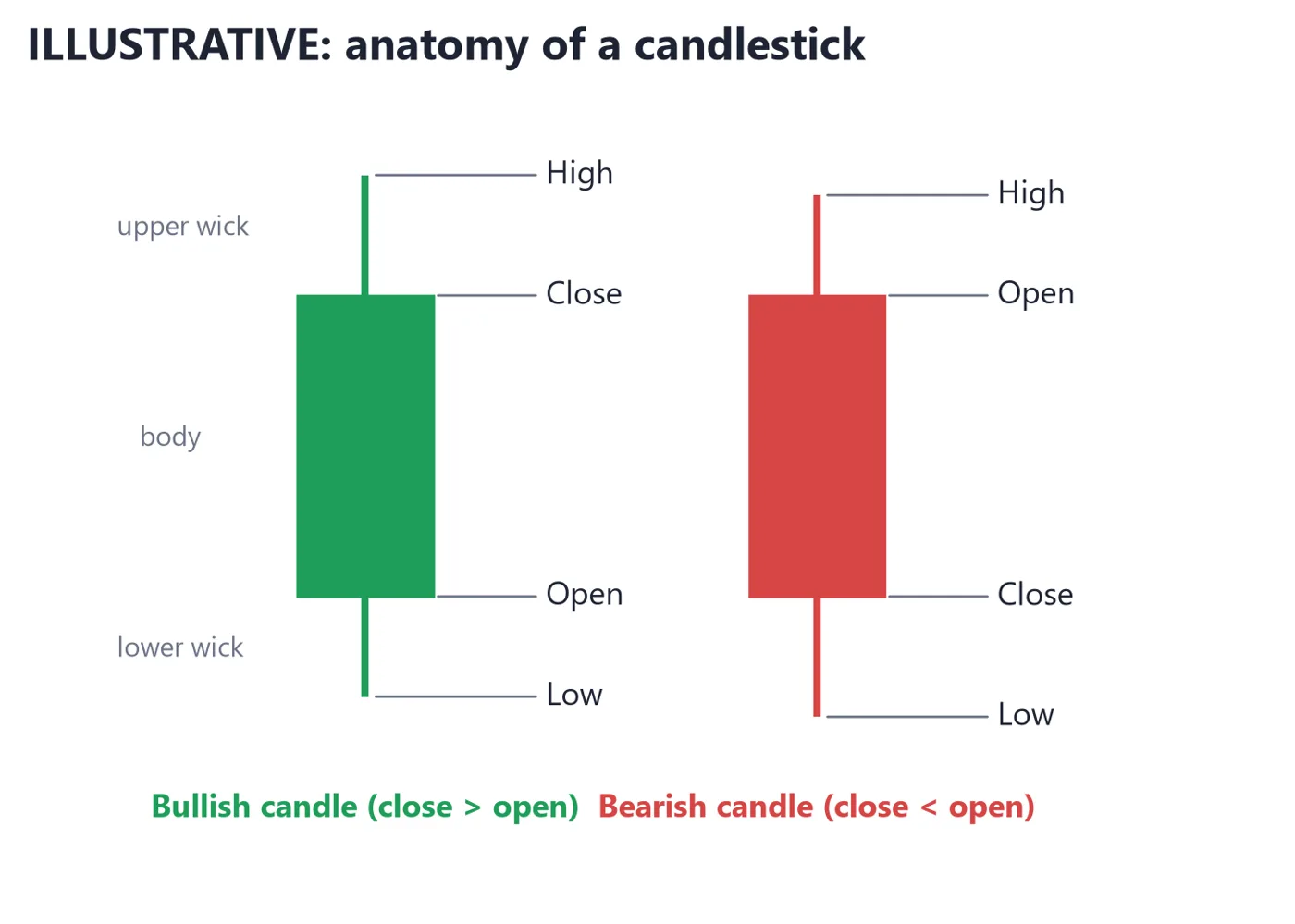
Looks likeA small body with upper and lower wicks of similar length.
Context mattersA sign of indecision, like a doji but with a slightly larger body. Common in ranges and during pauses.
Common mistakeOver-reading a minor pause. Many spinning tops appear in ordinary sideways trading.
Want the full path? Learn to Trade in 31 Days teaches futures and options one lesson a day, with charts and printable worksheets. wfeatherfinance.com/learn-to-trade-31-days
Educational only. Not financial advice. Trading futures and options involves substantial risk of loss. © 2026 White Feather Finance · wfeatherfinance.com