Lesson 4 · 10 min
Volume Profile as Support & Resistance
You’ll learn
- How HVN and LVN maps are drawn from prior days
- Why traders treat nodes as areas of interest, never exact lines
- How confluence with prior highs and lows is read, and why it can still fail
4.1 Nodes as places to pay attention
Support is a price area where buyers have stepped in before. Resistance is an area where sellers have. These are loose ideas; a zone is more realistic than a single price. The profile gives you a way to mark those zones from real activity rather than from a guess.
Remember the nodes from Lesson 1. An HVN (high-volume node) is a fat part of the profile where price spent time. An LVN (low-volume node) is a thin part where price moved quickly. Many traders mark both on a map before the session starts.
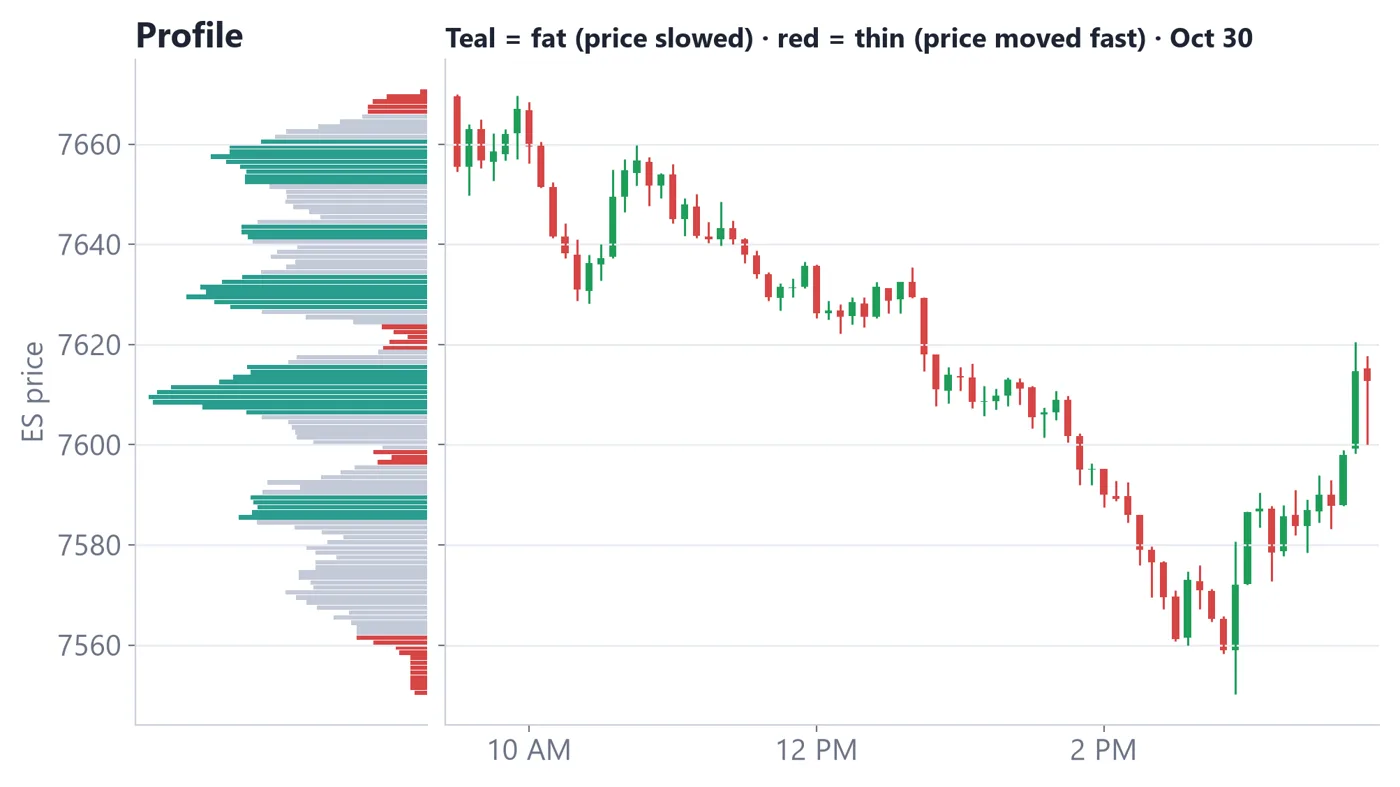
- 1Where the profile is fat (HVN), price slows and moves sideways.
- 2Where the profile is thin (LVN), price tends to move through quickly.
- 3One move can pass through several thin zones and pause at the next fat one.
4.2 How HVNs and LVNs behave
An HVN is a zone of past agreement. When price returns to it, some traders expect it to slow down or turn into a range again. That is a tendency seen on many charts, not a rule. Price can also slice straight through an HVN when a strong move is underway.
An LVN is a zone where price saw little acceptance. When price returns to an LVN, it often passes through quickly toward the next node. Some traders also watch LVNs as places where a reaction can be sharp, because there is little past business to cushion the move. The reaction can go either way.
| Node | Typical behaviour when price returns | What to watch for |
|---|---|---|
| HVN | Slowing, chop, a pause | Does price stall, or push through with strong momentum? |
| LVN | Fast travel through the zone | Does price hurry to the next HVN, or reject and turn back? |
| POC | Often a pivot or reference | Does price stay near it, or leave and not return? |
4.3 Making your map
- Mark yesterday's POC, VAH and VAL as zones, not lines. Give each a cushion of a few points.
- Scroll the profile back several days and mark the biggest HVNs above and below current price.
- Mark the thin LVN gaps between them. Label them 'fast zone'.
- Decide in advance what you will watch at each zone: does price stall, reject or accept?
Why build the map before the open? Because decisions made in the middle of a fast move tend to be worse than decisions made calmly beforehand. With a map, you already know which areas matter, so you spend the session watching what price does there instead of hunting for something to do. If nothing happens at your zones, nothing happens, and that is an acceptable day.
A zone of a few points is realistic on ES. A single tick (0.25 points, worth $12.50) is far smaller than the normal noise of a 5-minute bar, so a one-tick line will often be touched, crossed and crossed again. Keep your map to zones.
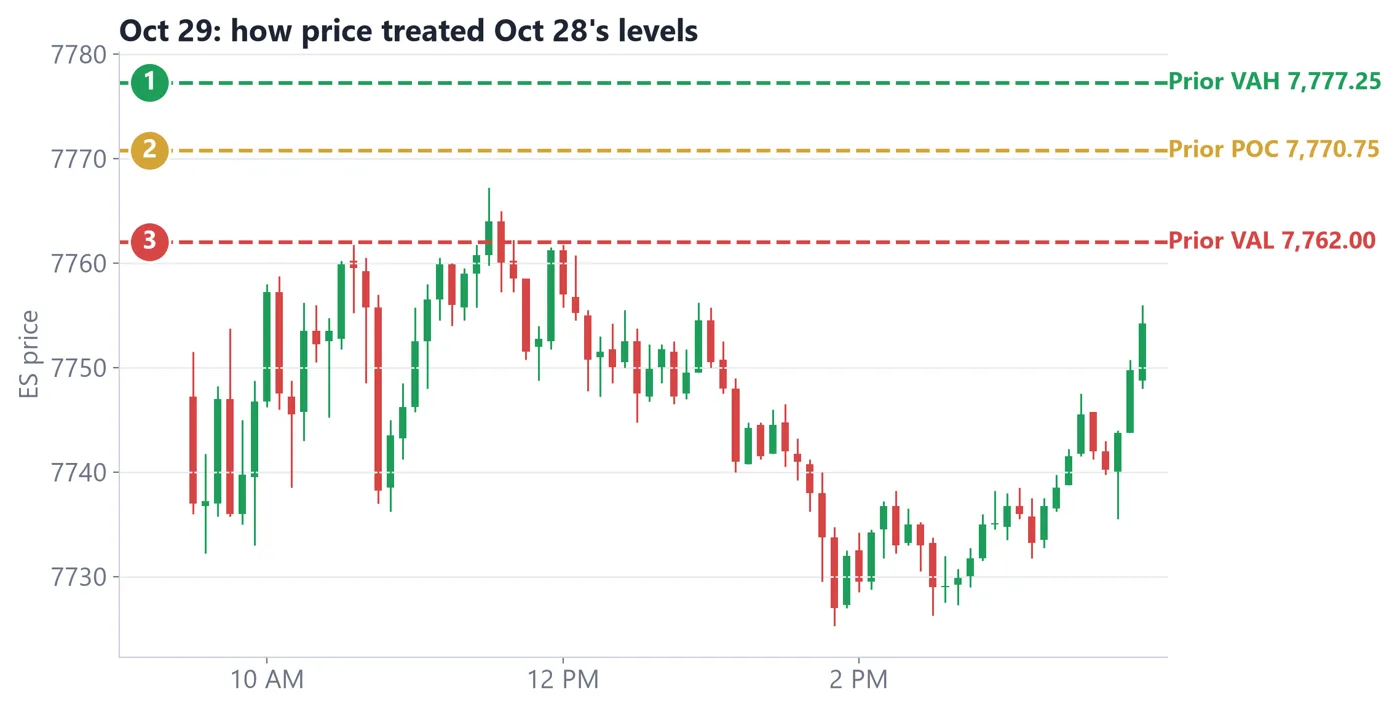
- 1Prior VAL of 7,762.00 was a reference; price opened below it at 7,747.25.
- 2Price traded above 7,762 only between 11:30 and 11:40 (high 7,767.25).
- 3Then it fell to a low of 7,725.25 at 1:50 PM. The level was visited and did not hold as support from below.
4.4 Confluence with prior highs and lows
Confluence means two or more reference points sit in the same area. A common example is a profile node close to the previous day's high or low. Some traders pay extra attention there because several tools point to the same zone.
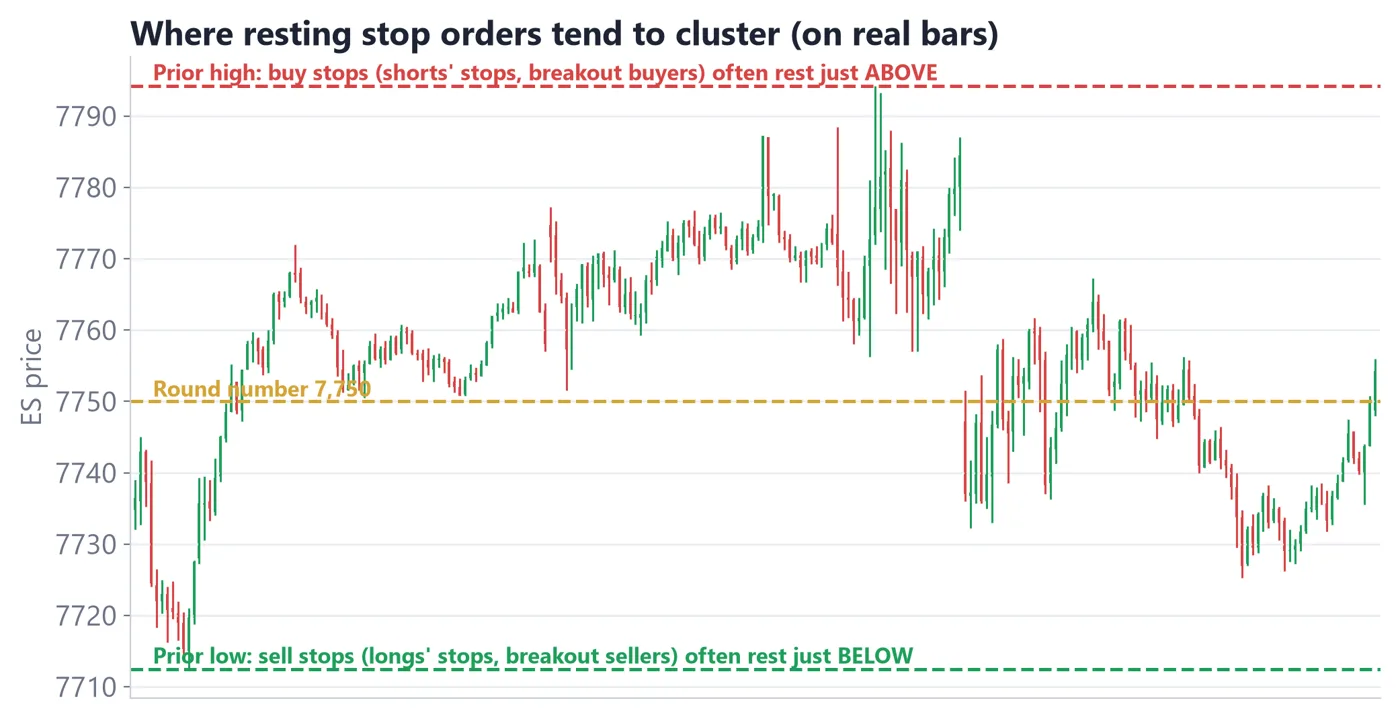
- 1Buy stops tend to sit above prior highs; sell stops tend to sit below prior lows.
- 2These areas can attract quick, sharp moves as the stops are triggered.
- 3A node close to one of these areas adds a second reason to watch the zone. It is not a reason to trade it.
It also helps to ask what would change your mind. If price pushes through a node and stays on the far side for a while, the node did not act as support or resistance that time. The same node may matter again on another day, or it may not. Write down which one happened so that your map stays honest.
Confluence raises your attention, not your certainty. Two weak reasons do not make a strong one. If a zone had both an HVN and a prior high and price still sliced through it, record that too. A journal of failures is as valuable as a journal of successes.
- HVNs are zones of past agreement; LVNs are zones price moved through quickly.
- Treat nodes as zones with a cushion, not single-price lines.
- Confluence with prior highs and lows adds attention, not certainty.
- Oct 29 shows a prior level can be visited and still fail to hold.
Quick check
Pass with 2 of 3 to complete the lesson (+20 XP, plus 5 XP per correct answer the first time).
1.An LVN is best described as a zone where price...
2.Why use zones instead of exact lines on ES?
3.What does confluence do?