Lesson 10 · 10 min
Initial Balance and Range Extension
You’ll learn
- How to mark the Initial Balance and its midpoint
- What narrow and wide IBs describe, and what they do not promise
- How range extension is observed and how to record it without predicting it
4.1 The Initial Balance
The Initial Balance (IB) is the high and low of the first hour of the regular session: letters A and B on a 30-minute TPO chart, or 9:30 to 10:30 AM ET. The idea is that the first hour contains the most active participation of the day, so its range is a useful frame.
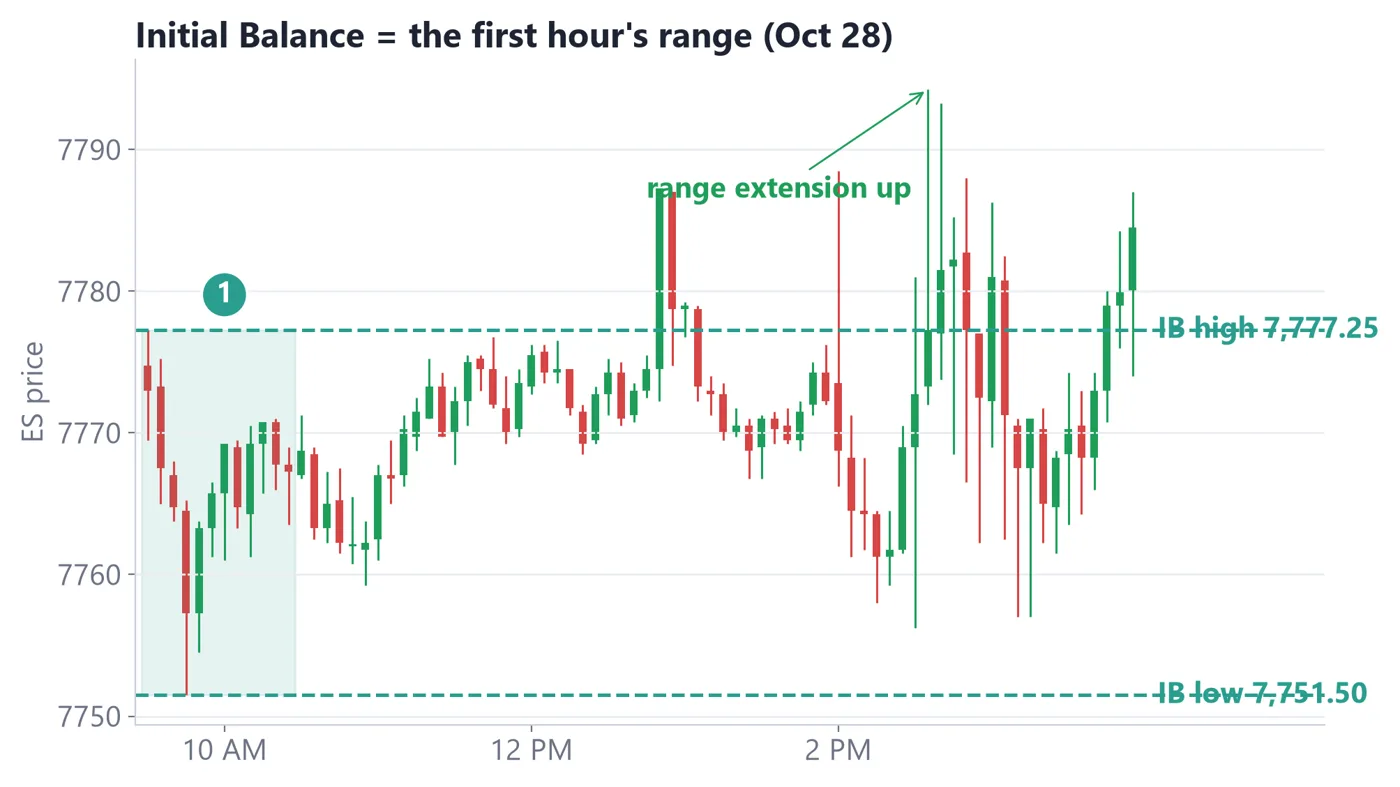
- 1The box spans the high and low of the first hour.
- 2Price that trades outside the box is a <b>range extension</b>.
- 3Watch whether the extension is brief or builds time and volume outside the box.
Why the first hour? In many sessions the opening period carries heavy participation as overnight orders meet fresh interest, so the early range tends to capture how the day began. The IB is not magic; it is simply a consistent, easy-to-mark frame that lets you describe every day the same way. Consistency is the point, because it lets you compare days fairly and build a record.
Mark the IB high, the IB low and the IB midpoint halfway between them. The midpoint is simply a reference line; many traders glance at it to see which half of the first hour's range price is in.
4.2 Narrow versus wide
IB width is the distance between the IB high and the IB low. A narrow IB is a small first-hour range compared with recent days. A wide IB is a large one. Width is relative: compare today's IB with your last several sessions rather than with a fixed number.
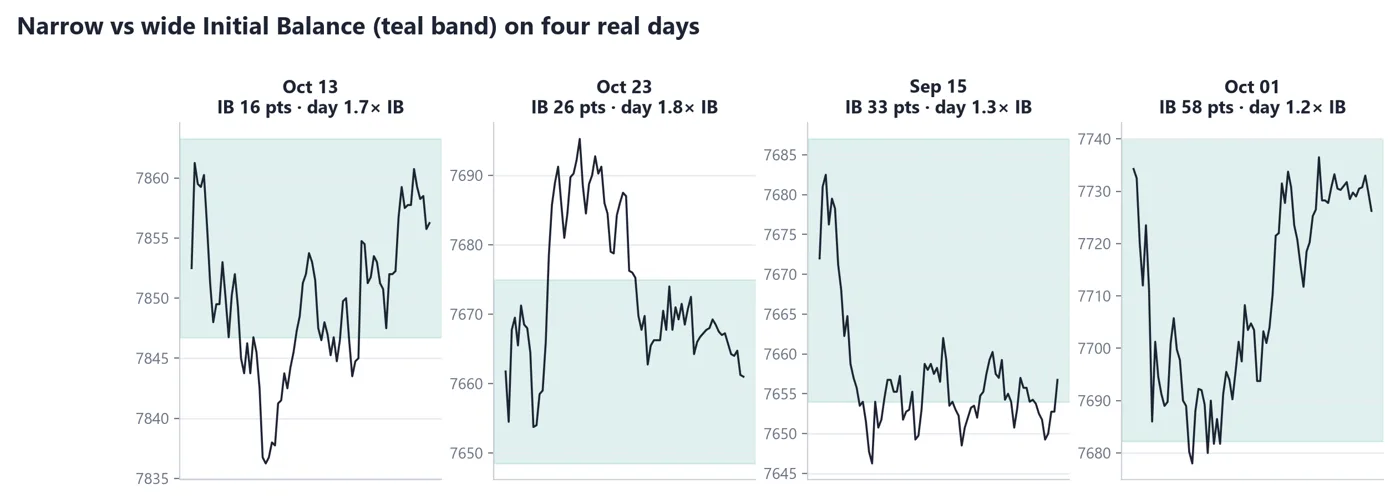
- 1Compare the box width with the full day's range afterwards.
- 2Some narrow-IB days extended a lot; others stayed small.
- 3Some wide-IB days stayed inside the box; others extended anyway.
| IB width | Common description | Careful reading |
|---|---|---|
| Narrow | Compressed early range; more room for extension | Extension happens on many narrow days but may not happen |
| Wide | Large early range; much of the day's work may already be done | Extension can still occur, especially after news |
The textbook pairing is: narrow IB, more chance of a big extension; wide IB, more chance of staying inside. Treat that as a pattern to test, not a rule. Look at the four examples above and in your own data, and see how often each description held.
4.3 Range extension
Range extension is trading outside the IB. It can happen on one side or, less often, both. Extension up means price traded above the IB high; extension down means it traded below the IB low. What matters is whether the extension is accepted (time and volume build outside) or rejected (price quickly returns inside).
It also helps to separate the size of the extension from its meaning. A small poke of a few ticks beyond the IB high is a very different event from a push of many points that spends hours above it. Ticks are $12.50 each on ES, so even a small poke is worth recording in points and ticks, but it should not be given the same weight as a sustained move. Describe each extension by how far, how long and whether it came back.
An extension that returns inside the IB is sometimes called a failed extension. It is a description, not an instruction. The same applies to extensions that hold: a hold is a description of what happened, not a promise that it continues.
Record the time of the first extension and how long it lasted. Many sessions extend once and then settle. Recording the details teaches you what is typical in the market you study.
- The IB is the first-hour range (letters A and B); mark its high, low and midpoint.
- Width is relative: compare today's IB with recent days.
- Range extension is trading outside the IB; track whether it is accepted or rejected.
- Narrow-IB-means-extension is a pattern to test in your own records, not a rule.
Quick check
Pass with 2 of 3 to complete the lesson (+20 XP, plus 5 XP per correct answer the first time).
1.The Initial Balance covers...
2.Range extension means...
3.A narrow IB means that extension...