Lesson 9 · 10 min
Liquidity and stop runs
You’ll learn
- What liquidity means and why stop orders matter
- Which side the stops sit on at highs and lows
- Why a sweep beyond a level is not always a reversal
3.1 Liquidity and stop orders
Liquidity means how easily you can trade without moving the price much. Where there are many orders resting, liquidity is deep. Where there are few, price can jump.
A stop order is an order that becomes a market order once price reaches a chosen level. Traders use stops to limit loss. There are two kinds that matter here. A sell stop sits below the current price and sells when price falls to it. A buy stop sits above the current price and buys when price rises to it.
Now the key point about sides. A trader who is long (bought, hoping for a rise) places the protective stop below their entry. That is a sell stop. A trader who is short (sold, hoping for a fall) places the protective stop above their entry. That is a buy stop.
Why does this matter for learning? Because many popular ideas about 'where the stops are' are based on guesses about other traders' behaviour. The guesses can be reasonable. Prior highs and lows are visible to everyone, so traders often place orders relative to them. But a reasonable guess is still a guess. You will never see the order list. What you can see is what price did when it reached the level.
3.2 Where stops tend to sit
| Place | Stops that may rest there |
|---|---|
| Just above a recent high | Buy stops from short sellers who placed protective stops above it, and buy stops from breakout traders who plan to buy a break of the high |
| Just below a recent low | Sell stops from long holders whose protective stops sit below it, and sell stops from breakdown traders who plan to sell a break of the low |
So the stops above a high are buy stops: they belong to short sellers protecting themselves and to breakout buyers. Long stops sit below lows. Equal highs, equal lows and round numbers draw attention from many traders, which is one reason some traders think orders may cluster there. We cannot see the orders. This is an inference about behaviour, not a reading of the book.
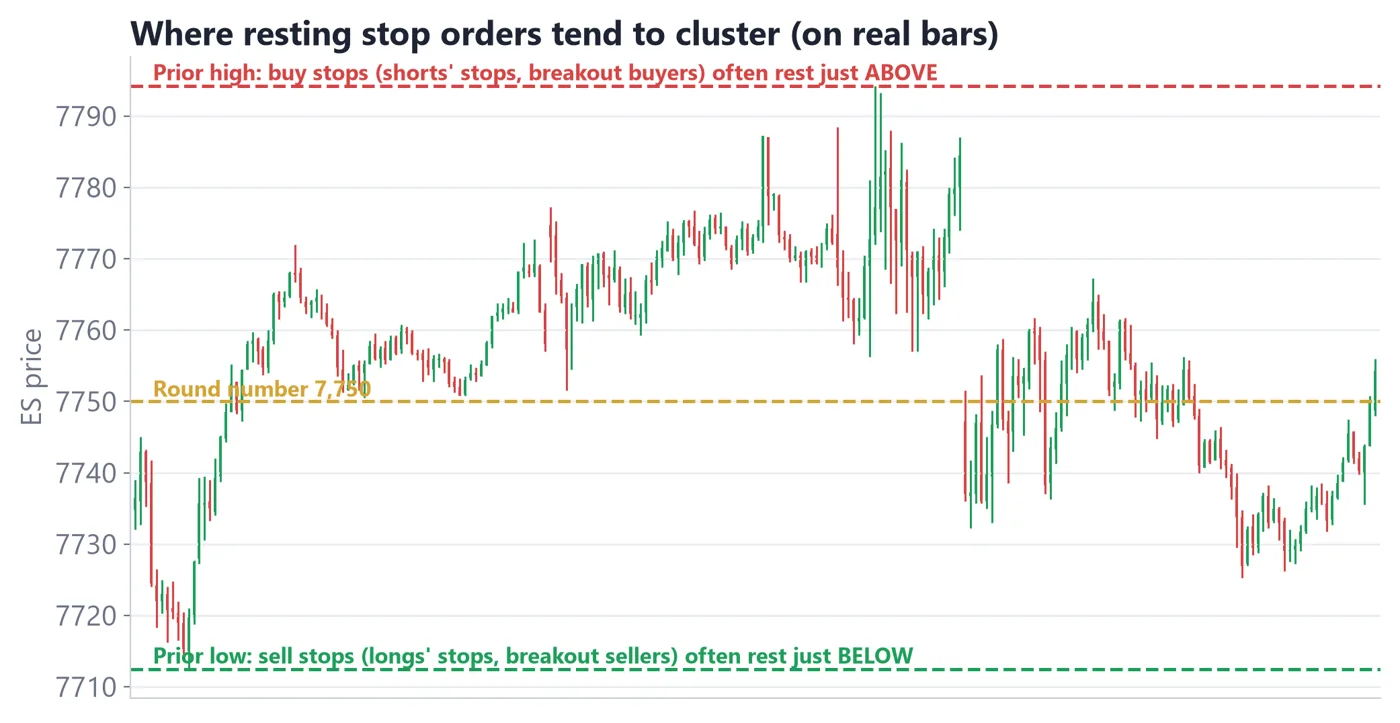
- 1Equal highs: buy stops from shorts and breakout buyers may sit just above.
- 2Equal lows: sell stops from longs and breakdown sellers may sit just below.
- 3A round number: many traders pick it, so orders may gather around it.
Round numbers add to this effect. Prices that end in 00 or 50 (for example a level like 7,800.00) attract attention because humans like round figures. Some traders place stops, targets and entries around them. That can make the area busier than nearby prices. Again, this describes where activity may happen, not which way price will go.
3.3 Stop runs, and when they are just breakouts
A stop run (or sweep) is a quick move beyond an obvious level that triggers stops, followed sometimes by a reversal. When the stops trigger, they turn into market orders, which adds buying or selling at that moment. If nobody is there to continue the move afterwards, price may snap back.
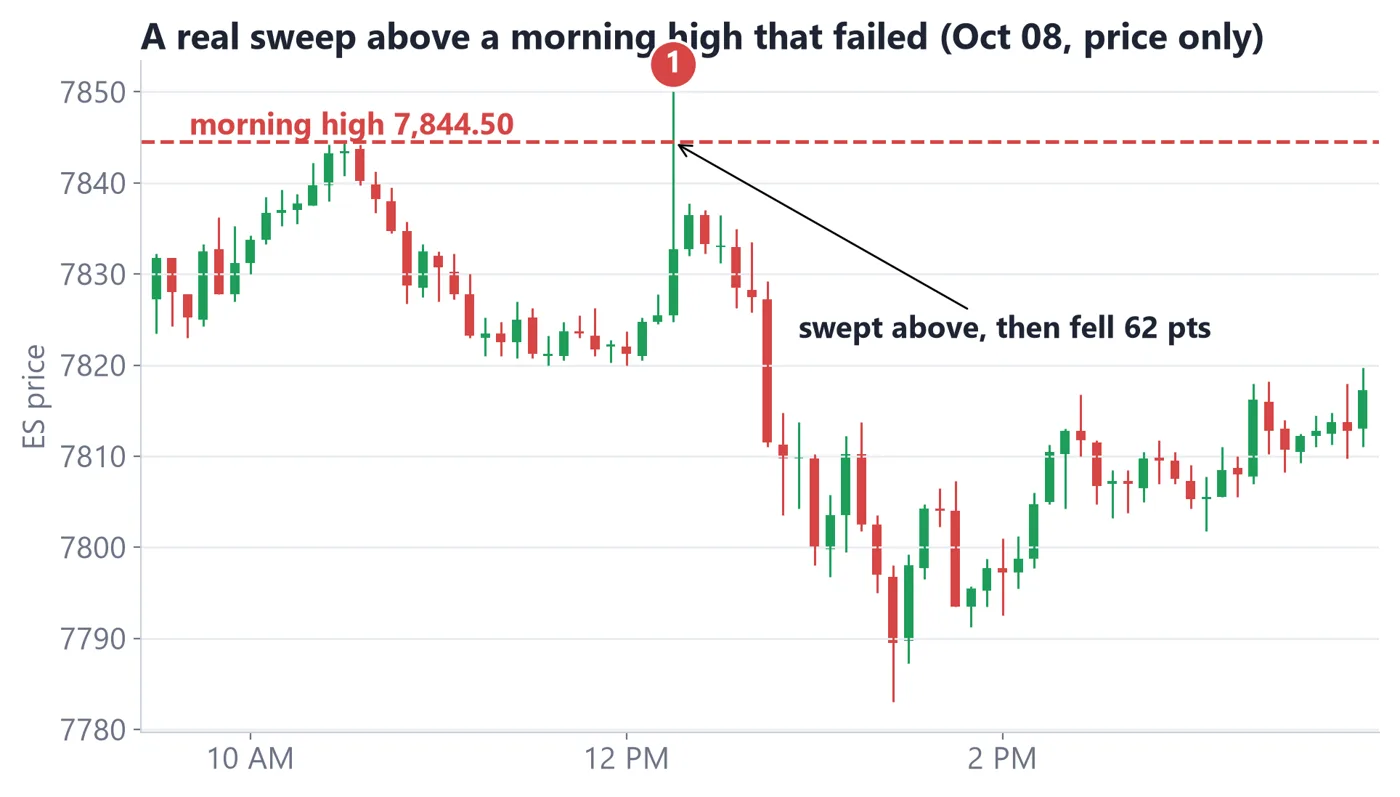
- 1Price pushes just beyond the level.
- 2Price returns back inside the range soon afterwards.
- 3This is price only: we cannot see the stops themselves.
Do not assume every poke through a level is a stop run. Sometimes it is simply a breakout, and price keeps going. Telling them apart in real time is hard. One approach is to wait for evidence that the move was not accepted, such as price trading back inside the prior range and holding there. Even then, define your risk before acting. A sweep that does not reverse is a loss for anyone who assumed it would.
Also remember that stops can be a reason for a move to continue. A cascade of stops being hit pushes price further in the same direction. Stop-run language only makes sense after you see what price does next.
- Long stops sit below lows; short stops and breakout buy orders sit above highs.
- Stops above a high are buy stops.
- Orders cannot be seen, so clustering is an inference.
- A sweep may reverse or continue; define your risk before acting.
Quick check
Pass with 2 of 3 to complete the lesson (+20 XP, plus 5 XP per correct answer the first time).
1.Where do the protective stops of long holders usually sit?
2.What kind of orders sit above a high?
3.Is every poke through a level a stop run?