Lesson 8 · 8 min
Anchored VWAP
You’ll learn
- How an anchored VWAP differs from session VWAP
- Common places to anchor it
- What anchored VWAP does and does not tell you
2.1 Choosing your own starting point
Session VWAP always starts at the session open. Anchored VWAP lets you pick the starting point yourself. From that point onward, the platform draws the volume-weighted average price since the anchor. The maths is exactly the same as in Lesson 1. Only the start changes.
That is all it is: the volume-weighted average price of every trade since the anchor. It is a tidy way to ask, 'Compared with the average price traded since that event, is the market now above or below?'
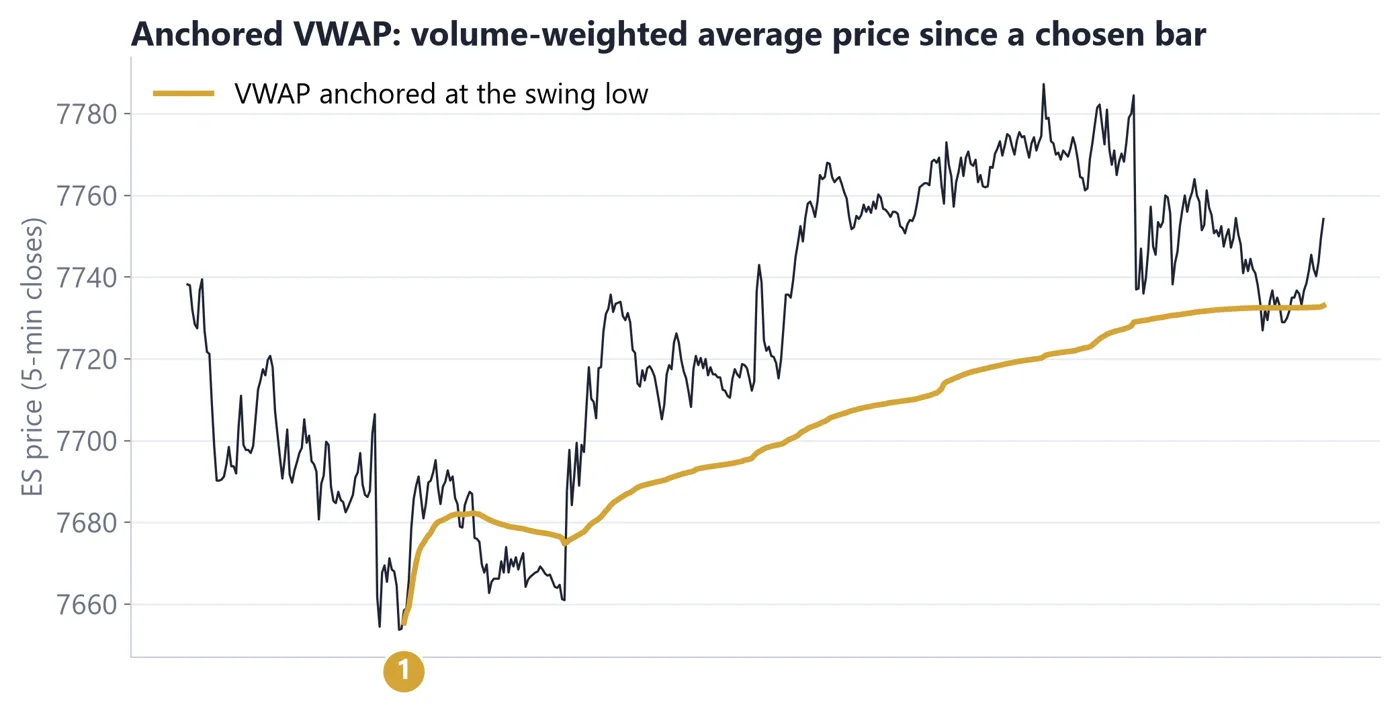
- 1The anchor sits on the swing low, so the line starts at that low's price.
- 2As trade continues, the line becomes an average of everything traded since the low.
- 3Price spends time above and below the line; it is a reference, not a rule.
Because the line starts at the anchor, the early part of an anchored VWAP is very sensitive. With only a few bars of data it hugs price closely and moves around. As more volume accumulates, it settles and becomes slower. This is the same behaviour as session VWAP in the morning, and it is a reason to be careful about reading too much into a line that was anchored only a few bars ago.
2.2 Where traders anchor it
| Anchor point | Question it helps answer |
|---|---|
| A swing low or swing high | Where is price relative to the average traded since that turning point? |
| The start of a news event | Where is price relative to the average traded since the news? |
| A gap day's open | How is price trading relative to the average since the gap? |
| The start of a week or a month | How does price compare with the average over a longer window? |
The choice of anchor changes the line. Two traders anchoring to different swing points will see two different lines on the same chart. That is not an error. It is a reminder that anchored VWAP is a tool shaped by your choice, so there is no single 'correct' line.
You can also use more than one anchored line at once. For example, one from a swing low and one from a swing high on the same chart. When price sits between the two, the chart shows a market that is above the average since the low and below the average since the high. That is a description of position, not a signal, and it shows why keeping the number of lines small helps you stay clear.
2.3 What it is not
You will often read that anchored VWAP is 'the institutional cost basis' or 'where big players are underwater'. Do not trust that wording. It is only the volume-weighted average price of trades since your anchor. It includes every participant who traded, on both sides, at every price. It does not tell you the cost of any individual or group.
Used honestly, anchored VWAP is a way to measure distance from an average that you chose, with a reason you can write down. 'I anchored to the swing low because it was the last major turning point' is a reason. 'I anchored where it made the chart look good' is not. Write the reason in your notes before you look at how price reacted.
Also keep in mind that anchored lines are not special. Price may respect one a dozen times and then trade through it. Treat each as a place to pay attention, plan your risk around it, and accept that sometimes nothing happens at all. Because anchored lines can be placed anywhere, it is easy to find one that 'worked' in hindsight. To avoid that trap, decide your anchors by rule before the session starts, such as the most recent major swing high or low, and stay with them for the day.
- Anchored VWAP starts the VWAP calculation at a point you choose.
- It is the volume-weighted average price since the anchor, nothing more.
- Different anchors give different lines; use few and give each a reason.
- It is not an institutional cost basis.
Quick check
Pass with 2 of 3 to complete the lesson (+20 XP, plus 5 XP per correct answer the first time).
1.What is the only difference between anchored VWAP and session VWAP?
2.What is anchored VWAP, correctly described?
3.Why should you write down the reason for an anchor?