Lesson 9 · 12 min
Case studies: three hypothetical walk-throughs
You’ll learn
- How to apply the Where, Why, When framework step by step
- How to do the ticks, points and dollars arithmetic
- What a loss and a skip look like when the rules are followed
8.1 Read this first
All three cases below are hypothetical. The prices, levels and footprint numbers are invented to practise the process. They are not real trades, not real results and not recommendations. Real trading involves substantial risk of loss, and results vary. The cases use the same scorecard and gates as Lesson 5 (every layer at least 1, total at least 5 of 6, target at least 2x the stop).
Arithmetic reminder for ES: 1 point = $50 and 1 tick (0.25 points) = $12.50, so 1 point = 4 ticks. Dollar figures are per contract and ignore commissions.
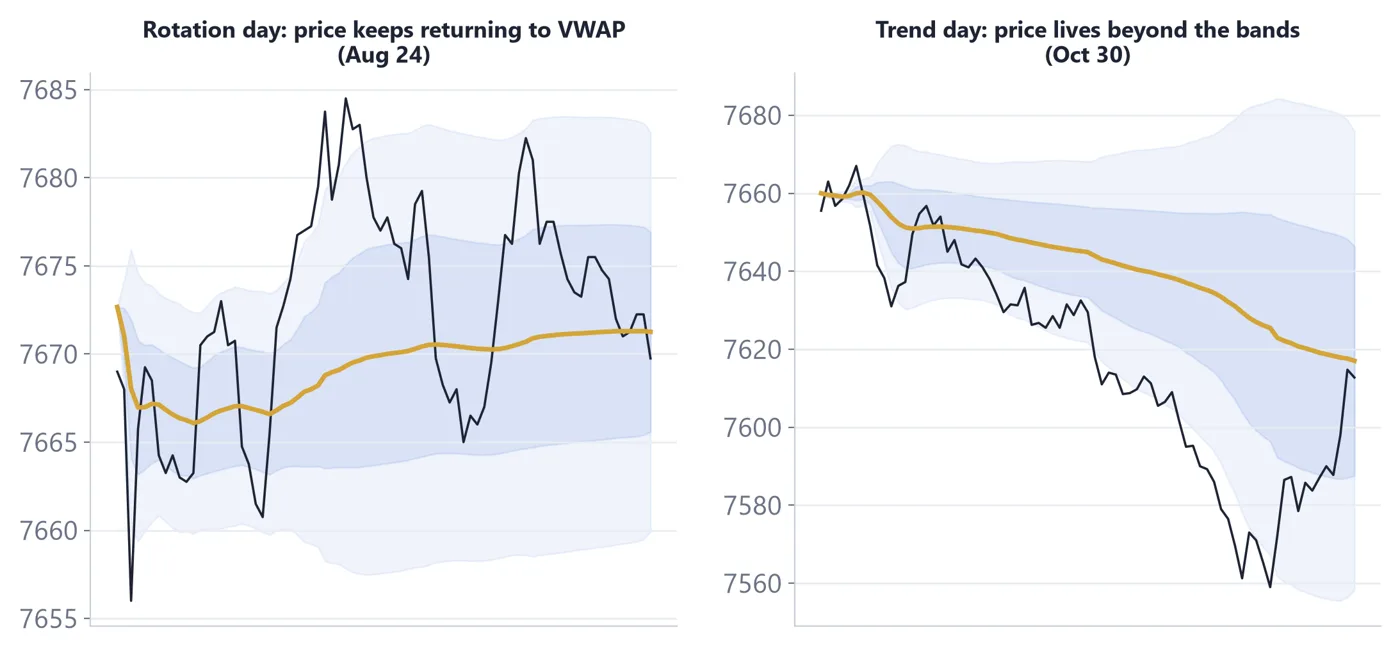
- 1Reversion day: trade returns to VWAP.
- 2Trend day: price stays on one side. Cases 1 and 2 are set on days like the first; Case 3 is set on a day like the second.
8.2 Case 1 (hypothetical): a win
Hypothetical example. Where: the prior day's VAL is 7,700.00 (invented). Price drops to test it from above at the open. Why: the market opened inside the prior value area, and VWAP is flat, which looks like a balanced day. When: heavy sell volume prints at 7,699.00 to 7,699.50 but price cannot make a lower low, which is consistent with absorption (heavy volume, no progress). The next bar turns delta positive.
Scorecard: Where 2, Why 1, When 2 = 5. All layers are at least 1, and the total is 5. Entry: buy at 7,701.00 after the confirmation bar. Stop: 7,698.50, which is 0.50 points below the absorbed low at 7,699.00. Stop distance: 7,701.00 - 7,698.50 = 2.50 points = 10 ticks = $125 risk. First target: the flat VWAP at 7,708.50. Target distance: 7.50 points = 30 ticks = $375. Reward to risk: 30 / 10 = 3.0R, so Gate 3 passes.
Result in this invented story: price reaches 7,708.50 and the trade is closed there. Gross gain: +7.50 points = +$375 = +3.0R, before commissions. One winning example proves nothing about the method. It only shows the arithmetic.
8.3 Case 2 (hypothetical): a loss that followed the rules
Hypothetical example. Where: the prior day's VAH is 7,725.00 (invented). Why: price opened inside value; the day looks balanced. When: price pushes to 7,725.00 and the footprint below shows volume drying up at the top, a thin tip, which is consistent with exhaustion.
Scorecard: Where 2, Why 1, When 2 = 5. Entry: sell short at 7,723.50 after the follow-up bar. Stop: 7,726.00, which is 1.00 point above the 7,725.00 high, where buy stops of shorts and of breakout buyers may rest (long stops would sit below a low, not here). Stop distance: 7,726.00 - 7,723.50 = 2.50 points = 10 ticks = $125 risk. First target: 7,716.00, which is 7.50 points = 30 ticks = $375 = 3.0R. Gates 1, 2 and 3 all pass.
Result in this invented story: price pushes through the high and the stop fills one tick worse than planned, at 7,726.25 (slippage). Actual loss: 7,726.25 - 7,723.50 = 2.75 points = 11 ticks = $137.50, which is 1.1R. The rules were followed and the trade still lost. A loss like this is an expected cost of a process. The useful review question is not 'why did I lose?' but 'did I follow the gates and the risk limit?' Here the answer is yes.
8.4 Case 3 (hypothetical): a skipped trade
Hypothetical example. Price rallies on a day like the trend day above and reaches the prior day's VAH at 7,740.00 (invented). Where scores 2: a marked level. Why scores 0: price has stayed on one side of VWAP all session, and VWAP slope is steeply up, so the context argues against the idea of a reversal. When scores 1: a small ask imbalance but no clear exhaustion. Total: 2 + 0 + 1 = 3.
Gate 1 fails (Why is 0) and Gate 2 fails (3 is under 5). Gate 3 would also fail: a short at 7,742.00 with a stop at 7,744.50 risks 2.50 points = 10 ticks = $125, but the nearest target at 7,740.00 is only 2.00 points = 8 ticks = $100 away, which is 0.8R, under the 2R minimum.
The decision is to skip. What price does next does not change whether the skip followed the rules. A skipped trade that would have won is still a correct skip, and a skipped trade that would have lost is not proof of skill. Record it in your log with the three scores and move on.
- Case 1: +3.0R, a win ($375 on 30 ticks). Case 2: a 1.1R loss ($137.50) that followed the rules. Case 3: a skip.
- 1 point = $50, 1 tick = $12.50; always convert stop and target to ticks and dollars first.
- Slippage and gaps can make a loss larger than planned.
- Hypothetical cases show process, not performance.
Quick check
Pass with 2 of 3 to complete the lesson (+20 XP, plus 5 XP per correct answer the first time).
1.In Case 1, what is the reward to risk?
2.In Case 2, why was the loss $137.50 and not $125?
3.Why was Case 3 skipped?